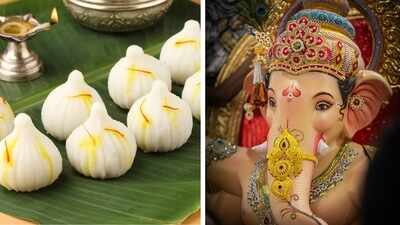
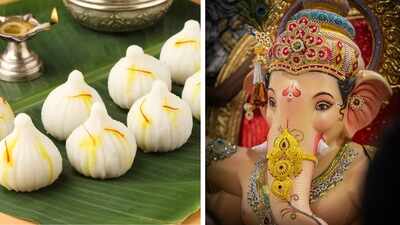
Ganesh Chaturthi is here, and with it comes one of the festival’s most loved traditions: offering modaks to Lord Ganesha. From homemade sweets prepared in family kitchens to beautifully arranged bhog at temples and pandals, the modak has become closely associated with the celebration.But have you ever wondered why the traditional offering is often 21 modaks? There is a popular story associated with the number, and it involves a hungry Ganesha, a single modak, and, rather unexpectedly, 21 burps.
The story behind 21 modaks
According to a popular traditional legend, Lord Shiva and young Ganesha once visited Anusuya, the wife of sage Atri.Anusuya wanted to feed Ganesha first and said that Lord Shiva would be served only after the child had eaten to his satisfaction. A variety of dishes were served, but Ganesha’s hunger seemed endless.When the food failed to satisfy him, Anusuya offered him something sweet. She gave Ganesha a modak.The little sweet finally satisfied him, and Ganesha gave a loud burp, signalling that he was full. At the same time, Lord Shiva is said to have burped 21 times.According to this popular retelling, Goddess Parvati later learned that the modak had satisfied her son and expressed the wish that 21 modaks should be offered to Ganesha by his devotees.This legend is one of the traditional explanations associated with the custom. Different regions and communities may narrate the story differently.
Why is modak associated with Lord Ganesha?
The connection between Ganesha and modak goes beyond the story of Anusuya.In Hindu devotional traditions, the sweet is closely associated with wisdom, knowledge, and happiness. Ganesha himself is worshipped as the deity associated with wisdom and the removal of obstacles, which has strengthened the symbolic connection between the deity and the sweet.
Why does the number 21 appear in Ganesha worship?
The number is not restricted to modaks.Durva grass, one of the traditional offerings made to Lord Ganesha, is also commonly offered in a count of 21. There are different traditional explanations for the significance of this number.One interpretation connects 21 with various aspects of human existence, including the organs of perception and action, vital energies, the mind, intellect, consciousness, and ego. In this understanding, the number represents the offering of one’s whole being to the divine.These interpretations coexist with the popular story of Lord Shiva’s 21 burps.
What kind of modak is traditionally offered?
The preparation differs across regions and families.One of the best-known varieties is ukadiche modak, particularly associated with Maharashtra. It has a steamed rice-flour covering and a filling made primarily from coconut and jaggery, with cardamom often added for flavour.Fried modaks and several regional versions are also prepared during Ganesh Chaturthi.
Why the tradition continues
The story of the 21 burps gives the number a memorable place in the festival, while the modak itself has remained one of the most recognizable offerings associated with Lord Ganesha.For devotees, offering the sweets is ultimately part of welcoming Bappa with love and seeking his blessings for wisdom, happiness, prosperity, and the removal of obstacles.Disclaimer: Religious stories and interpretations mentioned in this article are based on traditional beliefs and popular retellings. They are provided for informational purposes and may vary across regions and communities.Thumb image: Canva (for representative purposes only)