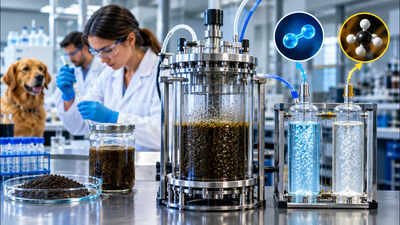
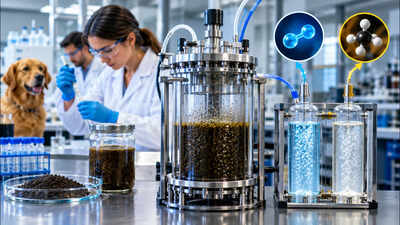
Dog waste is usually treated as an unpleasant urban problem, something to be collected, bagged and thrown away. But researchers are investigating whether it could instead become a source of renewable energy. A new study has examined dog faeces as a feedstock for producing biohydrogen and methane through anaerobic biological processes. The research, published in the Biochemical Engineering Journal, tested different treatment routes, including single-stage anaerobic digestion and a two-stage system combining acidogenic fermentation with anaerobic digestion. The findings suggest that canine waste contains enough biodegradable organic matter to generate useful biogas, although the results also show that methane, not hydrogen, is responsible for most of the recovered energy. In the study, more than 85% of the recovered energy came from methane across the tested approaches. The researchers say untreated wet dog faeces processed through single-stage anaerobic digestion offered the best balance between energy recovery and economic viability.
Dog faeces becomes a potential energy resource
The study began with a problem that is becoming increasingly difficult for cities to ignore. Dog faeces is generally classified as low-volume waste on an individual basis, but the enormous number of dogs in urban areas means the material accumulates in substantial quantities. It can also carry pathogens, making responsible collection and treatment important for public health. Researchers Karla Cruz-Torres, Martín Barragán-Trinidad and Dulce María Arias-Lizárraga investigated whether anaerobic digestion could offer an alternative to conventional disposal. In the research published in Biochemical Engineering Journal, they tested wet canine faeces under different anaerobic conditions. Anaerobic digestion uses microorganisms in an oxygen-free environment to break down organic matter and produce biogas, principally methane and carbon dioxide.
One process could produce hydrogen and methane
The researchers explored a two-stage approach in which dog faeces could first undergo acidogenic fermentation, generating hydrogen and other intermediate compounds, before the remaining material was subjected to anaerobic digestion to produce methane. They also compared this with single-stage digestion and examined whether acid hydrolysis could improve energy recovery. The research ‘Dual biofuel recovery from low-volume organic waste: A two-stage strategy for biohydrogen and methane production using dog faeces hydrolysates’ found that the two-stage process could recover energy in the form of both hydrogen and methane. However, hydrogen production was comparatively small. The study concluded that the contribution of hydrogen to total energy recovery was negligible when compared with methane. In every tested configuration, more than 85% of recovered energy came from methane, making methane the far more important fuel generated from the waste.
Untreated dog poop performed surprisingly well
One of the study’s more interesting findings was that treating the faeces before digestion did not automatically make the process better. The researchers compared untreated wet faeces with dried material and samples subjected to acid hydrolysis. Although pretreatment could improve certain aspects of the two-stage process, it also introduced additional processing requirements and costs. The research concluded that single-stage anaerobic digestion using untreated wet dog faeces offered the most favourable balance between energy recovery and economic viability. The researchers also noted that relatively low biogas yields in some experiments could be connected to insufficient acclimatisation of the microbial inoculum. That suggests that improving microbial adaptation and process stability could be important if this type of waste-to-energy system is developed further.
Could dog waste become renewable fuel?
The findings do not mean dog faeces is ready to replace conventional fuels or that every pile of dog waste could simply be converted into energy. The study was a technical and economic investigation of potential decentralised bioenergy production, and the researchers say further work, including life-cycle analysis, is needed to properly assess its environmental impact. Still, the concept illustrates how an awkward waste stream could potentially be incorporated into a circular system. Instead of sending collected dog faeces directly to landfill or another disposal route, anaerobic digestion could extract some of its chemical energy as biogas while leaving behind digestate. The study ultimately found methane to be the economically more promising energy product. What looks like waste on a pavement, therefore, could contain a small but potentially recoverable source of renewable energy.