Time has a way of taking almost everything away. Bodies decay. Tissues disappear, and even bones gradually change as millions of years pass. Out of the excruciating cycle of time, nature sometimes decides to find a loophole by preserving a few traces for us to find and know that we were not the only ones and we won’t be. One day, we find something that makes us wonder how that’s even possible, and the next, nature throws even bigger mind-boggling stuff at us. Something similar happened with a group of palaeontologists when they found dinosaur blood.When we think of dinosaur fossils, we usually imagine enormous skeletons, sharp teeth and footprints preserved in rocks for millions of years. But what if I told you that some fossils may hold traces of something far more delicate? In a study led by researchers at Curtin University, scientists examined a 115-million-year-old dinosaur fossil and reported evidence of structures resembling red blood cells, along with collagen-related molecules. The findings offer a rare glimpse into the biological material that may survive inside fossils long after an animal’s death.The findings were published in a study in the journal Proceedings of the National Academy of Sciences (PNAS), titled ‘Heme signatures in mineralised red blood cells within vascular canals of a 115-million-year-old dinosaur bone’.
The discovery of traces of dinosaur blood
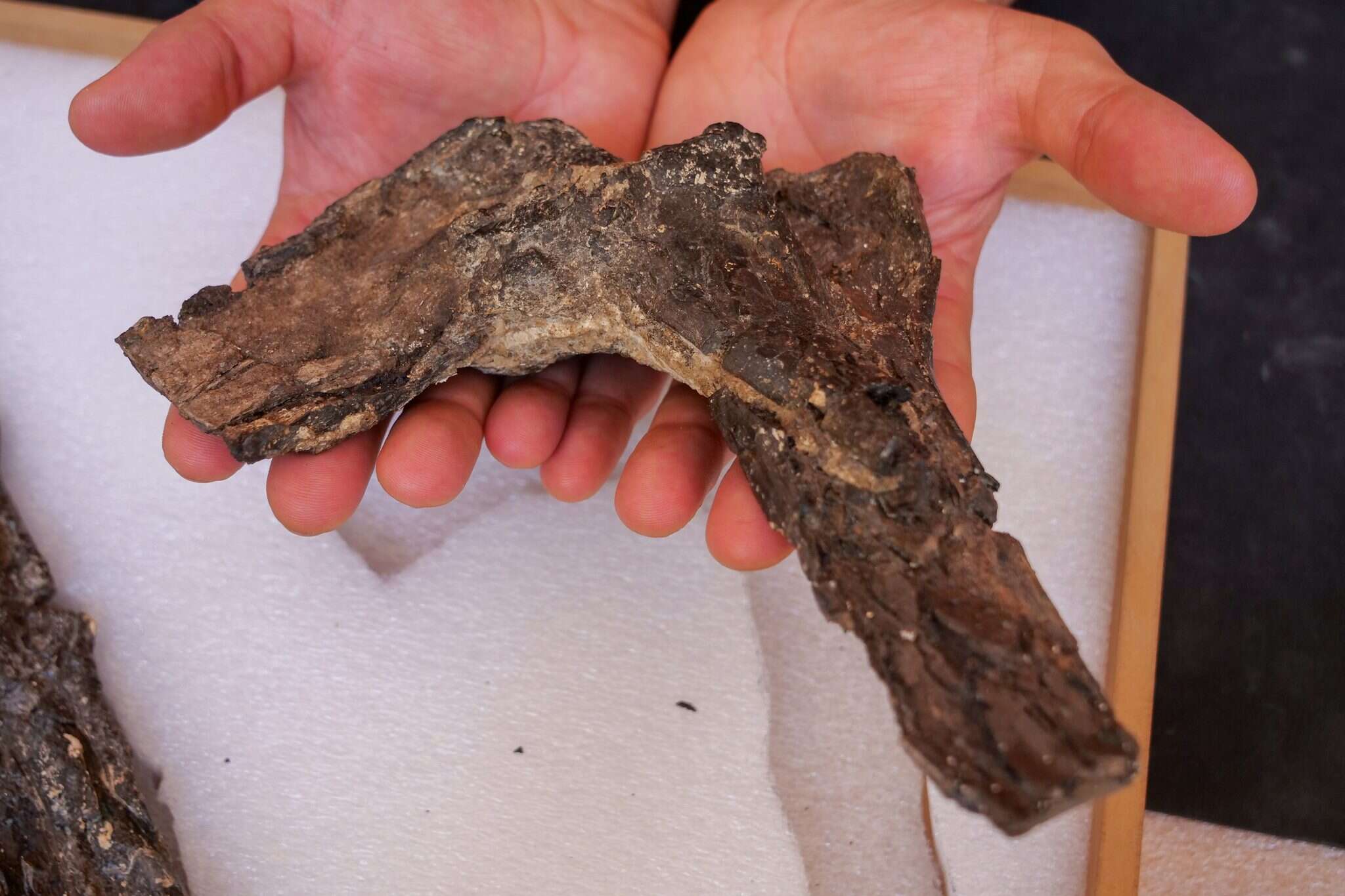
Image courtesy- Curtin university official website
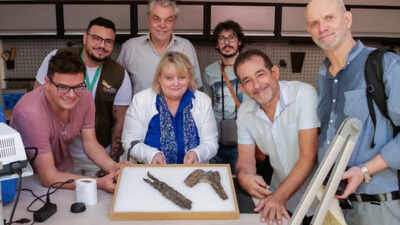
The research was led by Kliti Grice of Curtin University, along with an international team of scientists. They were examining the limb bones of Aratasaurus museunacionali, a theropod dinosaur that lived in what is now northeastern Brazil around 115 million years ago. The fossil bones, which were discovered in a Brazilian mine in 2008, held something researchers did not expect to find.While examining the samples, scientists noticed tiny, oval-shaped structures inside the vascular canals of the bones. These canals are the pathways through which blood vessels once passed. The structures appeared similar to red blood cells, but the researchers needed more than their appearance to establish what they were.The team therefore used several advanced chemical and imaging techniques to investigate them. Using high-performance liquid chromatography-mass spectrometry, researchers identified heme B and its altered forms in the bone extracts. Heme is an iron-containing molecule found in haemoglobin, the protein that allows red blood cells to transport oxygen throughout the body.Further analysis using Raman spectroscopy and transmission electron microscopy revealed chemical signatures associated with heme inside the structures, along with elements such as iron, nitrogen and carbon. Researchers also identified the mineral hausmannite, which may have helped stabilise the structures and preserve the biological traces over millions of years.Along with blood, the team also detected traces of collagen in the fossil. Together, these findings provide evidence of blood-derived molecules and collagen-related material surviving in a dinosaur fossil for approximately 115 million years.But the question still remains: how exactly did the blood survive for 115 million years?
How did dinosaur blood survive for 115 million years?
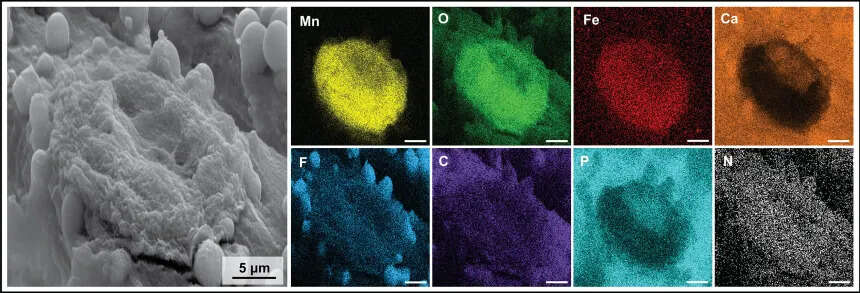
A red blood cell-like structure found inside the fossils of the dinosaur (Curtin University)
Normally, blood cells and other soft tissues begin breaking down soon after an animal dies. Microorganisms, oxygen and natural chemical processes gradually decompose these delicate structures, making their preservation over millions of years extremely difficult.Researchers believe the answer could lie in the environment in which the dinosaur died and was eventually buried. According to the study, the animal may have been rapidly buried in a low-oxygen environment rich in microbial mats. These are thin layers of microorganisms, including bacteria and archaea, that commonly develop in shallow-water environments. Such conditions may have slowed normal decomposition and created an environment favourable for the preservation of delicate biological structures.However, the researchers believe another factor played an equally important role. They found that the cell-like structures were mineralised with hausmannite, a manganese oxide mineral. This mineral may have acted like a protective casing, helping stabilise the microscopic structures and their associated chemical components before they could completely break down.In other words, the researchers believe that a combination of favourable burial conditions and early mineralisation of the fossil may have helped preserve traces of biological material that would normally disappear. Beyond explaining how these traces survived for millions of years, the discovery unravels something more fundamental. Until now, our understanding of these creatures came from bones, teeth and fossilised footprints. However, finding blood-derived molecules and collagen-related material offers researchers a completely new way to look at them, potentially revealing details that skeletal remains alone could not tell us. It also raises the possibility that fossils may hold far more biological information than scientists have been able to uncover so far.