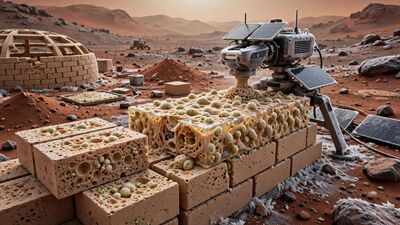
Scientists have developed a living building material designed for construction on Mars, combining inert sand with a gelatin-based hydrogel and engineered yeast cells. According to the research published in Chem Circularity titled ‘Engineered living building material for low-energy construction on Mars’, the material can be processed and printed under simulated Martian conditions while requiring far less processing energy than conventional regolith sintering, which involves heating mineral material to temperatures above 1,000°C. In recycling experiments, crushed material from existing bricks was used to produce new bricks while retaining mechanical performance and yeast viability. The findings point to a potential route for lower-energy, reusable construction materials for future Mars missions.
How scientists developed a living Mars building material using engineered yeast
Researchers developed a Martian living building material, or MLBM, using inert sand and a water-based gelatin and engineered-yeast hydrogel binder. In tests, the mixture was first set under ambient conditions before being freeze-dried at −55°C and 0.0001 atm for 48 hours. As the process progressed, the water froze and then turned directly into vapour, while gelatin crosslinking formed a porous scaffold around the sand particles.The engineered ‘Saccharomyces cerevisiae’ cells displayed adhesive proteins on their surfaces and became embedded within the scaffold walls. Researchers demonstrated extrusion-based printing under simulated Martian conditions. A scaled-down beacon was successfully fabricated at 0.01 atm and −30°C, showing that the material could be printed and stabilised in conditions resembling the Martian surface.
Engineered yeast strengthened the material and refined its structure
The engineered yeast strengthened the material when combined with gelatin. The strongest formulation used the engineered ScA-M strain and contained 25% biological components in the total solid substances added to the hydrosol.It produced a compressive strength of about 12 MPa and a flexural strength of 6 MPa, along with improved stiffness and toughness compared with the benchmark hydrogel-based concrete. Microscopic analysis showed that the yeast cells helped form smaller, more uniform, and better-connected pores. The AGA2-displaying yeast also contributed to this structural refinement.
Lower-energy construction on Mars
The Martian living building material has a much lower processing energy demand than conventional regolith sintering. Within the study’s defined processing boundary, the authors estimate that its energy requirement is several tens of times lower than representative sintering methods, which heat mineral feedstocks above 1,000°C.However, this is only a first-order estimate of material-level processing energy rather than a complete process or mission energy budget. It does not account for microbial cultivation, nutrient supply, bioreactor pressurisation, mixing, pumping, temperature control, water recovery or other operations.The optimised formulation also relies on Earth-derived porcine gelatin and externally supplied microbial nutrients. A gelatin-free version could reduce these imported inputs, but stronger fully biological binders and a complete assessment of mass and energy use are still needed.
How did researchers recycle the Mars building material
The study also tested whether MLBM could be reused after exposure to extreme conditions. Researchers crushed the original mother bricks made with biological components and ScA, then used the recovered material to produce new child bricks. They tested recycling both the gel and sand, as well as recovering yeast cells from the freeze-dried bio-gel.Both approaches preserved the material’s mechanical properties and kept the yeast cells viable across repeated recycling. The authors suggest that the binder undergoes a reversible sol-gel transition during thermal processing, allowing it to crosslink during freeze-drying. However, several properties still need to be assessed, including radiation tolerance, permeability, thermal conductivity, long-term durability, direct tensile behaviour, and performance during full-scale fabrication.