

Aamdani atthanni, kharcha rupaiya!It is a familiar refrain, and a financial loop the common man spends a lifetime trying to escape.For India’s middle class, much of working life revolves around one big aspiration: earning enough to afford not just the essentials, but also the little pleasures and milestones that make the grind worthwhile.A bigger paycheque promises more than a fatter bank balance. It means the freedom to make that impulsive purchase, finally book that long-awaited holiday, put money into an investment or simply save a little more towards a secure future.Yet, the closer that promise seems, the more elusive it becomes. Because every salary hike brings with it a familiar question: how much of that extra money will actually stay?For many Indian households, annual increments are increasingly being eaten up by rising everyday expenses, leaving little room to feel richer, save more or get ahead financially.
Which items have become more expensive
Companies are offering average salary hikes of around 9%, yet households are reporting higher spending on essentials, rising financial commitments and declining confidence about the economy.The Reserve Bank of India’s (RBI) September 2026 survey found that 90.1% of urban households were spending more on essentials than a year ago. Meanwhile, 54.5% felt the economic situation had worsened, compared with 40.9% in September 2025.The problem, therefore, is not simply how much people earn, but how much of that income survives after paying for necessities and accounting for inflation.With food prices climbing, fuel costs adding to the burden and household borrowing increasing, a rising pay packet does not necessarily mean a bigger financial cushion.Jyoti Prakash Gadia, managing director of Resurgent India Limited, said that the rising cost of basic necessities was eating into the disposable income generated by salary increases. Housing, healthcare, education, transport, EMIs and insurance premiums were claiming a larger share of household budgets, limiting the improvement in purchasing power.“Although there has been some growth in household income levels, the increasing cost of basic necessities has placed pressure on the disposable income levels,” Gadia said.
Attractive hikes on paper
For someone working a corporate job, appraisal season often brings a glimmer of hope and, over the past few years, salary hikes have given employees some reason to look forward to it.A recent Aon’s salary survey found that companies offered an average hike of 9% in 2026 and expect to increase salaries by 9.1% in 2027.Deloitte’s survey of India Inc. also projected an average increment of around 9.1%.At first glance, that sounds like exactly what every 9-to-5 employee waits and works for. But by the time those numbers translate into actual money in the bank, the excitement can begin to fade.For instance, with September’s retail inflation standing above 5%, a 9% salary hike translates into an approximate 3.3% gain in real terms, based on the headline inflation figure. However, the actual benefit can look quite different once taxes, deductions and individual spending patterns enter the picture.Government labour data paints a more uneven picture.According to the ministry of statistics and programme implementation’s (MoSPI) latest Periodic Labour Force Survey for 2025, average monthly earnings of regular salaried men increased by 5.8%, from Rs 22,891 to Rs 24,217. For women, the increase was 7.2%, from Rs 17,126 to Rs 18,353. Self-employed men recorded a wage increase of around 6%.For casual workers, however, the numbers offer little reason to celebrate. Average daily wages for male casual labourers remained virtually unchanged at Rs 455, compared with Rs 456 earlier.When salaries stay the same but grocery bills, travel costs and other expenses keep rising, making it through the month itself can become a challenge.Gadia said that the gap between income growth and the cost of living was particularly difficult for households with large fixed commitments. Even when salaries increased, rising EMIs, insurance premiums and other recurring payments could leave families with little additional disposable income.
Food prices take a bigger bite
The biggest source of pressure is increasingly visible in grocery bills. Retail inflation climbed to 5.54% in September this year, its highest level under the new Consumer Price Index (CPI) series.This was also the fourth consecutive month that inflation remained above the RBI’s 4% target.Food inflation rose sharply to 7.74% in September from 5.97% in August. Some everyday kitchen essentials became considerably more expensive, with onion prices increasing 108% year on year, ginger becoming 63% costlier and garlic prices rising 55%.The pressure has been particularly pronounced in rural India.Rural inflation stood at 6.08%, compared with 4.88% in urban areas, while rural food inflation reached 8.06%.The weather has added to the challenge.The India Meteorological Department reported that the 2026 monsoon ended at 87% of the long-period average, its weakest performance since 2015. The possibility of El Niño conditions peaking in November has also added uncertainty to the agricultural outlook.The government’s foodgrain production target for 2026-27 stands at 373.93 million tonnes, lower than the 376.56 million tonnes recorded in the previous year.For households, the impact is difficult to avoid. People can postpone buying a new phone, cut down on restaurant visits or cancel a holiday, but groceries remain a monthly necessity.Gadia said families were increasingly prioritising basic needs and becoming more selective about discretionary purchases. Higher rent, tuition fees, medical expenses and utility bills were leaving households with fewer options to adjust their budgets.“Today, families find themselves having tighter household budgets due to the rising expenses in basic necessities like accommodation, education, health care, food and transport,” he said.He added that households were increasingly opting for bargain shopping, delaying non-essential purchases and cutting back on entertainment, travel and lifestyle expenses to keep their finances stable.
Why your monthly budget just doesn’t add up
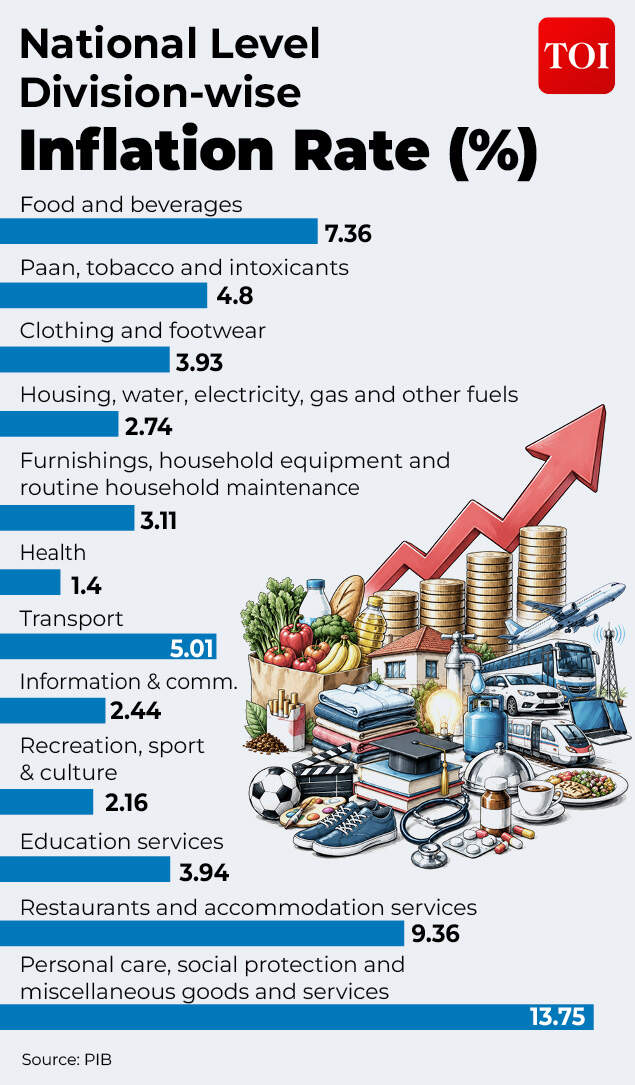
There is another reason households may feel more pressure than the headline inflation figure suggests: everyone’s spending basket is different.MoSPI’s Household Consumption Expenditure Survey (HCES) for 2023-24 found that food accounted for 47.04% of household spending in rural India and 39.68% in urban areas.Average monthly per capita consumption expenditure stood at Rs 4,122 in rural India and Rs 6,996 in urban India.When food inflation rises to 7.74%, households that devote a larger share of their income to groceries naturally feel a greater squeeze.The new CPI series has also reduced the weight assigned to food and beverages from 45.86% to 36.75%, reflecting changes in household consumption patterns.This means food price increases have a smaller influence on the headline inflation number than they did under the previous series.Not every expense, however, is rising at the same pace. September data showed inflation in housing and fuel at 2.74%, education at 3.94% and healthcare at 1.40%. Food and beverages recorded inflation of 7.36% under the category-wise CPI classification, while restaurants and accommodation saw a sharper increase of 9.36%.This is why two families earning identical salaries can have very different experiences.A household paying rent, school fees and home loan instalments may have considerably less flexibility than one with fewer fixed commitments.There is also a difference between inflation slowing and prices actually falling. Even if inflation comes down, it only means prices are increasing at a slower rate. It does not reverse the price increases households have already absorbed.Gadia pointed out that housing, education and healthcare costs could continue to rise faster than a family’s income even when overall inflation appeared to be under control. This can erode the advantage of salary increments, particularly for households whose earnings growth is low or unpredictable.
Household confidence is slipping despite higher incomes
The gap between official inflation and what people experience is also reflected in RBI’s consumer surveys.In September, households reported median perceived inflation of 8.4% and expected it to reach 10% over the next year.This is considerably higher than the official retail inflation rate of 5.54%.Interestingly, the difference between the two has narrowed over the past year.In September 2025, households perceived inflation at 7.4%, even when official CPI inflation was just 1.44%. While perceived inflation has increased by around one percentage point since then, official inflation has climbed by approximately four percentage points.
Countries that got rich — and how long it took them
Consumer confidence has also weakened.The RBI’s urban current situation index fell from 96.9 in September 2025 to 87.9 in September 2026. Its rural counterpart declined from 100.9 to 90.6.A reading below 100 indicates that more households view economic conditions as worsening than improving.The difference between essential and discretionary spending is particularly telling. Among urban households, the net response on spending on essentials stood at 88.4, while the corresponding reading for non-essential purchases was just 4.6.In simple terms, households are continuing to spend where they have little choice, but are becoming far more cautious about everything else.Gadia told TOI that this change was visible in the way families were approaching their monthly budgets. They were cutting back on discretionary spending, postponing large purchases and turning to less expensive alternatives. Regular expenses, including subscriptions and consumer credit payments, were also becoming part of the household budget calculations.
Rising oil prices could make the squeeze worse
Food is not the only expense putting pressure on household budgets. Fuel prices have added another layer of uncertainty.The US-Israel war on Iran, which began on February 28, has kept crude oil prices elevated. Petrol and diesel prices were increased by Rs 3 per litre on May 15, marking their first hike in nearly four years.Union oil minister Hardeep Singh Puri said state-run refiners were incurring losses of around Rs 10 billion a day while keeping retail fuel prices low.The pressure is not limited to petrol and diesel bills. Higher crude prices can increase transportation, manufacturing and distribution costs, eventually feeding into the prices of goods and services.Wholesale inflation offers an indication of these pressures. It rose to 11.39% in September, almost double the retail inflation rate.Fuel and power prices increased 25.85%, while manufactured goods inflation reached 9.76%.However, higher wholesale inflation does not automatically translate into an equivalent increase in retail prices. Businesses may initially absorb some of the additional costs, depending on their margins, competition and demand. If these pressures persist, they could eventually pass on part of the burden to consumers.RBI governor Sanjay Malhotra has cautioned that “inflation and its outlook are not benign, as they were last year”.The central bank expects headline inflation to average nearly 5.8% over the next three quarters.At the same time, a depreciating rupee could add to the problem by making imported inputs more expensive.
Households are borrowing more, but are they saving enough?
When monthly expenses begin to outpace income growth, borrowing can become a convenient way to bridge a gap. But loans also bring another fixed expense into an already stretched household budget.RBI data show that household debt increased to 45.9% of GDP in March 2026, compared with 36.4% in June 2022. During this period, household debt increased 78%, while financial assets grew 49%.In 2025-26, households added Rs 42.9 lakh crore to their financial assets but also took on Rs 21.4 lakh crore in fresh loans. Net financial savings declined to 6.2% of GDP from 7% earlier.The composition of borrowing is another concern.
Those families who have large EMI or low emergency funds are at particular risk in case of any financial shocks. Regular savings impact retirement plans in the future.
Jyoti Prakash Gadia, Managing Director, Resurgent India Limited
According to the RBI’s Financial Stability Report, non-housing retail loans, including personal loans, credit card debt and gold loans, account for 58.4% of household debt.Delinquencies in small-ticket loans increased to 6.4% in March 2026.Higher interest rates could make repayments more expensive. For instance, assuming a full pass-through, a 0.25 percentage point increase in the interest rate on a Rs 50 lakh home loan with a 20-year tenure, initially priced at 8.5%, would raise the monthly EMI from approximately Rs 43,391 to Rs 44,186.That is an additional Rs 794 every month.For a household already juggling groceries, school fees, rent and other bills, even a seemingly small increase can make a difference.Gadia cautioned that households relying on credit cards, personal loans and long repayment plans to meet short-term financial needs could find themselves under greater pressure over time. While borrowing may offer temporary relief, interest costs can add to the burden and reduce the money available for savings.He also noted that families facing higher expenses may cut back on discretionary savings or dip into existing reserves. Such adjustments may help in the short term, but can affect longer-term financial goals, including retirement planning.The pressure is particularly acute for households with large EMIs or inadequate emergency funds, which may have limited capacity to absorb an unexpected financial shock.The expert told TOI, “Having an emergency fund that consists of enough money to last for up to six months of living costs is also vital. Households need to reduce unnecessary borrowing, assess their insurance and make steady investments according to their goals and risk tolerance. Diversifying their savings in appropriate financial instruments may also assist them in mitigating risks.”
Will your next salary hike be enough?
The coming months will offer a clearer picture of whether income growth can withstand the renewed inflationary pressure.With wholesale inflation running significantly higher than retail inflation, the possibility of businesses passing on additional costs remains a concern. If retail inflation moves towards the RBI’s projected average of 5.8%, the real benefit of a 9% salary increase could shrink to around 3.2%, based on a simple comparison of the two figures.Against the 8.4% inflation households currently perceive, however, the difference falls to just 0.6 percentage points. This is an illustrative calculation, rather than a measure of actual household purchasing power.The next retail inflation reading is scheduled for November 12, followed by wholesale inflation data on November 16.The RBI’s next monetary policy meeting is scheduled for December 2-4.
A household must develop a systematic way of handling its finances through regular assessments of its income, expenditure, liabilities and savings obligations. Budgeting for oneself realistically and focusing on necessary spending and cutting out unnecessary monthly expenses can help one be more financially flexible.
Jyoti Prakash Gadia, Managing Director, Resurgent India Limited
For households, the bigger question is whether their earnings can keep pace with the rising cost of necessities without forcing them to borrow more or cut back on savings. For businesses, it is whether higher input costs can be passed on to customers who are already becoming cautious about discretionary spending.For individuals, Gadia recommends a more systematic approach to managing household finances. This includes regularly reviewing income, expenses, liabilities and savings commitments, identifying avoidable monthly costs and ensuring that investments are aligned with financial goals and risk tolerance.He also recommends maintaining an emergency fund capable of covering up to six months of living expenses, while reviewing insurance coverage and avoiding unnecessary borrowing.Ultimately, a salary hike is only one part of the financial picture. What matters is how much money remains after the monthly bills are paid, loan instalments are cleared and essential purchases are made.Because a bigger pay packet may look good on paper, but the real raise is what helps you escape the ‘mehengai ki maar!’