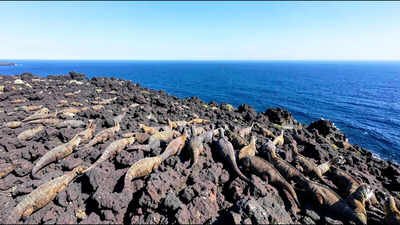
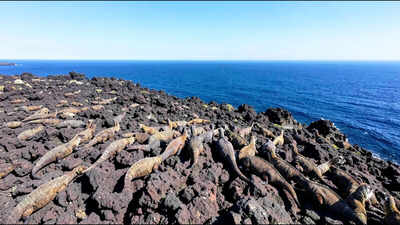
Marine iguanas can be difficult to spot against the dark rocks of the Galápagos Islands, making them challenging to count during conservation surveys. Yet reliable population estimates are important for protecting the species, for which complete population-size data are missing across most subspecies. A team of researchers has tested whether online volunteers can help analyse the large volumes of imagery collected by drones. In a study titled Citizen scientists reliably count endangered Galápagos marine iguanas from drone images, published in Scientific Reports on July 24, 2025, Registered and anonymous participants made 1,375,201 classifications of 57,838 aerial images through Zooniverse. The study recorded 13,988 participant identifiers, including approximately 3,500 anonymous identifiers. Comparisons with expert assessments showed that volunteers could contribute reliable counts, although they tended to miss some iguanas. The findings offer a way to support wildlife monitoring, but further work is needed before the approach can produce accurate population estimates.
Galápagos marine iguana count: How volunteers analysed 57,838 drone images
The researchers collected aerial images of marine iguana colonies along rocky coastlines in the Galápagos between 2020 and 2022. They used DJI Mavic 2 Pro drones flown from land and boats at altitudes of 20 to 30 metres. The photographs were combined into georeferenced maps called orthomosaics, which were then divided into smaller images averaging 1,000 by 1,000 pixels. The team uploaded these images to Iguanas from Above, a citizen-science project on Zooniverse. Volunteers were asked to identify whether marine iguanas appeared in an image and mark the locations of individual animals. They could also record other species, including sea lions, crabs, green turtles and seabirds, as well as plants, algae and plastic objects.The study examined 3 phases of the project. The first included 24,373 images from San Cristóbal and Santa Fe, the second 9,097 images from Española and Floreana, and the third 24,368 images from Genovesa, Marchena and Pinta. Each image received 20 independent classifications in the first 2 phases and 30 in the third. The project’s 3 phases were completed in September 2023. The researchers promoted participation through press releases, newsletters, webinars, schools, universities, social media and other outreach activities. The project was available in English, Spanish, French and German, and its discussion board allowed volunteers to exchange information with researchers and other participants.
Citizen-science accuracy: Why volunteers sometimes missed iguanas
To evaluate the results, the researchers created a reference dataset of 4,345 images. Two researchers assessed the images independently, while a third reviewed disputed cases to establish the reference counts. Marine iguanas were identified in 418 images, about 10% of the dataset. The researchers noted that the large proportion of blank images skewed the accuracy figures and may have contributed to missed iguanas. They also reported that blank images could reduce volunteer motivation. When experts found no iguanas, volunteer assessments agreed with the expert results 99.6% of the time. Images containing iguanas proved harder to classify. Depending on the project phase, volunteers correctly identified their presence in 68% to 94% of those images. False negatives, in which volunteers missed iguanas that experts had identified, were more common than false positives.The researchers also compared different ways of combining the volunteers’ answers. A standard majority-vote method performed less well than a minimum threshold requiring at least 5 volunteers to indicate that an image contained an iguana. For counting individual animals, the team tested several aggregation methods, including the median, mode and 2 clustering algorithms. HDBSCAN performed best by grouping volunteers’ marked locations into spatial clusters to estimate the number of individual iguanas.After excluding the lower-quality pilot phase, volunteer counts achieved 91% to 92% accuracy compared with expert counts in phases 2 and 3. The researchers found that volunteers tended to undercount iguanas, meaning their results would need correction before being used to estimate population sizes. Even with these improvements, the researchers found a tendency to undercount iguanas. They concluded that a correction factor would be needed before volunteer-generated counts could be used to estimate population sizes reliably. Participation was also uneven. About 86% of volunteers made fewer than 50 classifications, while 174 participants each classified more than 1,000 images. The 10 most active contributors accounted for 18% of all classifications.
Marine iguana conservation : Why drones and machine learning matter
The research addresses a major gap in marine iguana monitoring. According to the study, complete population-size data are lacking for 9 of the species’ 11 subspecies, largely because surveying the animals is challenging. The IUCN Red List classifies the marine iguana as vulnerable. Drones allow researchers to survey remote coastal areas while reducing the risks and effort associated with fieldwork. However, they also generate large image collections that require extensive analysis. Citizen science can help process this material, although the study found that the work remains resource-intensive. Each phase took between 5 and 14 months to complete, and the method still required expert assessments to evaluate accuracy.The researchers plan to develop machine-learning tools to help automate the process. Volunteer classifications could be used to train software to recognise iguanas in aerial images, while automated filtering could remove images without animals and direct attention towards more useful material. The same imagery could also support future research into breeding behaviour, including the presence of leks and males displaying breeding colours, as well as habitat characteristics.The study builds on earlier research by Varela-Jaramillo and colleagues, published in Frontiers in Zoology in 2023, titled A pilot study to estimate the population size of endangered Galápagos marine iguanas using drones, which compared drone-based marine iguana surveys with traditional ground-based counts. The new findings suggest that citizen scientists can help researchers analyse these images at scale, provided that their results are carefully combined and checked. The researchers shared classifications for the 4,345-image reference set through figshare. The research team acknowledged support from organisations including the Galapagos Conservation Trust and the International Iguana Foundation, alongside other institutions. The paper was dedicated to Pamela Van Schouwen, a long-time volunteer who died in August 2024.The findings show that online volunteers can contribute to wildlife monitoring by helping researchers process large collections of drone images. But because the volunteers tended to miss some animals, their counts cannot yet be treated as definitive population estimates without further correction and validation.