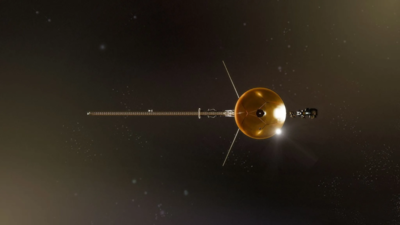
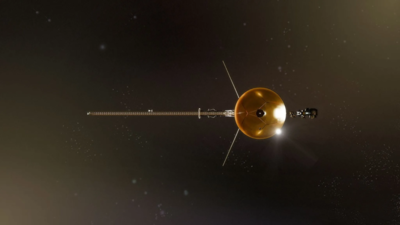
Nearly 50 years after it began its journey from Earth, Nasa‘s Voyager 1 spacecraft is set to cross a milestone that no other human-made object has reached. On Wednesday, the spacecraft will be approximately 25.9 billion kilometres from Earth, a distance so vast that even a signal travelling at the speed of light will take 24 hours to reach it.The milestone is known as one light-day. This makes Voyager 1 the most distant human-made object in existence, which continues to travel through interstellar space while sending scientific data back to Earth.According to Nasa, Voyager 1 is expected to reach the one-light-day mark at 5:16:07 am EST on Wednesday. At that point, a radio signal sent from Earth will take a full day to reach the spacecraft. A response from Voyager 1 would take another 24 hours to return, making a two-way communication exchange a wait of nearly 48 hours.
What is a light-day and how far is Voyager 1?
A light-day is the distance light travels through space in 24 hours. Since light moves at approximately 300,000 kilometres per second, one light-day is equivalent to around 25.9 billion kilometres, or 16.1 billion miles.The term is a measurement of distance, not time. It is part of the same system used to describe cosmic distances through light-seconds, light-minutes and light-years. For perspective, sunlight takes about eight minutes and 20 seconds to reach Earth, while light from the Moon takes just over a second.Voyager 1 will have taken 49 years, two months and 11 days to travel this distance from Earth. It is moving at approximately 61,000 kilometres per hour, but even at that speed, it has taken nearly five decades to reach the milestone.
What is Voyager 1 and why was it launched?
Voyager 1 is a robotic space probe launched by the Nasa on September 5, 1977, from Cape Canaveral in Florida. It was designed to study the outer planets of the solar system, particularly Jupiter and Saturn, and their moons, rings and magnetic fields.Its launch was part of Nasa’s Voyager programme, which involved two spacecraft sent to explore the outer solar system. Voyager 2 was launched first, on August 20, 1977, while Voyager 1 followed a faster, shorter trajectory and overtook its twin in December that year.The missions were planned around a rare alignment of the outer planets that allowed spacecraft to use the gravitational pull of one planet to travel towards another. This technique, known as a gravity assist, helped reduce the time required to reach distant planets.Voyager 1 reached Jupiter in March 1979 and Saturn in November 1980. During its flybys, it sent back observations and images that helped scientists study the planets, their moons and their rings. Its trajectory after the Saturn encounter took it away from the plane in which most planets orbit the Sun and towards interstellar space.
Where is Voyager 1 headed?
Voyager 1 is travelling in the direction of the constellation Ursa Minor, also known as the Little Bear. It is moving towards the general direction of a star called Gliese 445, also designated AC+79 3888, which is more than 17 light-years away from Earth.However, the spacecraft is not expected to reach the star itself. Nasa estimates that in around 40,000 years, Voyager 1 will pass within approximately 1.7 light-years of it.The spacecraft crossed the heliopause in August 2012, becoming the first human-made object to enter interstellar space. The heliopause is the boundary of the heliosphere, the vast region influenced by the Sun’s charged particles and magnetic field. Beyond it, Voyager 1 is travelling through the interstellar medium, the matter and radiation present between stars.Voyager 2 is the twin spacecraft of Voyager 1 and was launched 16 days earlier, on August 20, 1977. However, the two probes followed different trajectories and explored different parts of the outer solar system.While Voyager 1 visited Jupiter and Saturn before heading towards interstellar space, Voyager 2 continued its journey beyond Saturn to explore Uranus and Neptune. It remains the only spacecraft to have conducted close-up flybys of both planets.Voyager 2 crossed the heliopause in November 2018, becoming the second spacecraft to enter interstellar space. It is travelling in a different direction from Voyager 1 and is approximately 3.2 billion kilometres closer to Earth.According to Nasa, Voyager 2 is expected to reach the one-light-day distance from Earth in November 2035, around nine years after its twin.
The Golden Record
Along with its scientific instruments, Voyager 1 carries a 12-inch gold-plated copper disc known as the Golden Record. It was designed as a message from Earth to any extraterrestrial life that might encounter the spacecraft in the distant future.The record contains sounds and images intended to represent the diversity of life and human culture on Earth. It includes greetings in 55 languages, music, natural sounds and images depicting people, animals, scientific information and everyday life.The Golden Record was included on both Voyager spacecraft as a symbolic representation of humanity, rather than as a message intended for any known destination or recipient. As Voyager 1 continues its journey through interstellar space, the record remains a time capsule of life on Earth carried farther from the planet than any other human-made object.