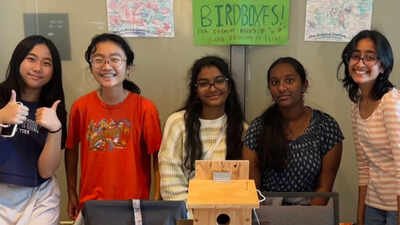
A California student has won a first-place award for developing a technology-based project to study birds and support their conservation. Pooja Verma of Fremont was among the winners of the 36th annual ‘A Voice for Animals’ contest organised by the Animal Welfare Institute (AWI) and the Humane Education Network.Verma launched a nonprofit organisation, Eco Innovate, to develop bird boxes fitted with solar-powered microprocessors and LED infrared cameras. The cameras capture photographs of nesting birds every three minutes.According to the contest’s official website, the photographs are intended to provide information about the behaviour of birds, including their nesting, mating and migratory habits. The project focuses on birds such as tree swallows. The information collected through these cameras can help track bird populations and understand their activities.Verma’s project has also reached 10 local schools. Eco Innovate distributed its bird boxes to these schools and organised workshops to teach students how to design and programme them. The organisation now plans to expand the project across California and other parts of the country.
How Pooja Verma’s bird boxes work
The bird boxes developed by Eco Innovate combine solar-powered technology with cameras to observe nesting birds. They contain solar-powered microprocessors and LED infrared cameras. The cameras take photographs at three-minute intervals.This allows the project to collect images of birds without depending on people to observe them continuously. The photographs can provide data about different stages of bird activity, including nesting and mating.The project also looks at migratory habits. Studying these patterns can help researchers understand how birds use different locations during their lives.Tree swallows are among the birds covered by the project. By using the images collected through the boxes, the initiative aims to improve population tracking.Eco Innovate has also taken the project into schools. It distributed the surveillance boxes to 10 local schools and conducted workshops for students. These sessions focused on teaching them how to design and programme the boxes for population tracking.The organisation plans to take the initiative beyond these schools and expand its reach across California and the country.
More than 500 entries in contest
The award was announced by the Animal Welfare Institute on November 5. The 36th annual ‘A Voice for Animals’ contest received more than 500 entries from students around the world.The competition is open to students aged 14 to 18. It gives them an opportunity to win cash prizes for essays and videos exploring ways to protect endangered species and reduce animal suffering.This year, the organisers also introduced a special category asking students to examine the role of the US Endangered Species Act (ESA) in protecting threatened species.Entries were judged on their presentation, originality and the effectiveness of the proposed solutions to animal-related problems.A total of 25 students received honours for their essays or videos. Their submissions covered a range of issues, including the impact of the opioid crisis on dogs, conflicts between humans and bears, Indigenous-led orca conservation efforts and the effect of poaching and wildlife trafficking on pangolin populations.Regina Terlau-Benford, AWI’s Humane Education Program director and co-manager of the contest, said the entries showed how young people were approaching animal protection challenges.“Time and again, these young advocates rise to the occasion by presenting thoughtful, well-researched submissions that demonstrate creative problem-solving in tackling some of the most serious threats to animals,” she said.She added that the winning students had gone beyond explaining problems and had suggested ways to address them.“This year’s group of honorees is no exception. They don’t just articulate vexing problems; they provide actionable insights to create a better world for animals,” Terlau-Benford said.Verma was one of seven first-place winners. The others included Charlotte He of New York, who suggested ways to prevent bird strikes against glass; Esma Mine Ersoy of Turkey, who wrote about Florida panther conservation; Naz Gul Ali Madad of Canada, who focused on protecting northern spotted owls; Renari Frazier of Maryland, who called for stronger ecosystem protection; Aaryan Ghorpade of North Carolina, who developed a web platform to track roadkill; and Joveena Marian of Bengaluru, who highlighted the suffering of captive elephants used in temples, circuses and tourism.