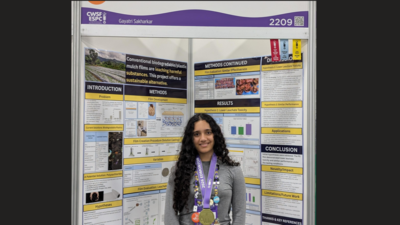
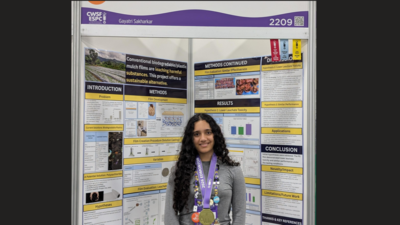
Gayatri Sakharkar, a 15-year-old Grade 10 student from Calgary, has developed a substitute for agricultural plastic film made from orange and pineapple peels, eggshells, and cellulose derived from waste paper and leaves. She says it degrades harmlessly in soil and leaves no toxicity. She states that university lab tests and planting experiments showed it boosts soil productivity as effectively as commercial alternatives. Sakharkar won silver in the 2026 Canadian Youth Science Fair competition and received a 2026 award from the Institute for Sustainability Education and Action. In the 21 September 2026 piece, she says she will continue her research at a University of Calgary lab.
What waste materials did Gayatri Sakharkar use to make the farming film
According to National Observer, Sakharkar’s film is made from pineapple and orange peels, eggshells, and cellulose derived from waste paper and leaves. She describes it as a substitute for the commercial plastic film that gardeners and farmers use in their fields.Each ingredient has a role, she says. The cellulose and the calcium from eggshells give the film strength, pineapple peels add flexibility, and orange peels provide pectin to hold it together. She states that, unlike traditional films, hers degrades harmlessly in the soil and leaves no toxicity behind.
Why does Gayatri Sakharkar say conventional plastic films harm soil
Sakharkar says gardeners and farmers use commercially available plastic film to help face worsening droughts, heat and aggressive pests. She states that most film degrades into microplastics that pollute crop soil and human bodies.She adds that even “biodegradable” options often fail to break down in soil. She says they can leave harmful residues even if they are industrially composted later. In her account, her own film avoids these risks. She says she has tested it in university labs and through planting experiments, and that it boosts soil productivity just as effectively as commercial alternatives. The National Youth Climate Activism Award site, which carries an excerpt of the piece, says the film “leaves no toxic trace”.
What inspired Gayatri Sakharkar to develop plastic-free farming film
Sakharkar was eight years old when she visited family in India and saw her grandparents using plastic film on their farm. She says she could see they needed to take advantage of every opportunity to improve their yields. She was troubled by the amount of plastic being used, which she already knew was a major problem worldwide. A few years later, she began asking whether plastic could be made another way than from fossil fuels. She followed reading trails from news pieces into journals and science articles and found a piece about using banana peels as a plastic substitute.She then wondered whether other fruit peels might work and started copying the methods she had read about. She says she boiled many different mixtures and did a lot of predictive math. She asked her school teachers for help and sent many cold emails to science professors at the university. She describes the work as difficult because chemistry requires failing before succeeding. She says she would boil one mixture that worked and be unable to replicate it without understanding why, but she got there eventually.
What awards has Gayatri Sakharkar won for her invention
Sakharkar won silver in the 2026 Canadian Youth Science Fair competition. She also received a 2026 award from the Institute for Sustainability Education and Action, which the National Youth Climate Activism Award site lists among its winners. This fall she will continue her research at a lab at the University of Calgary. She says the aim is to understand the properties of the film further and prepare for potential commercialisation.Sakharkar says she began the project to help her grandparents and has since begun to hope her work might help everyone. Asked what she sees if the world gets this right, she answered: “Sustainable solutions are accessible and fair.” She tells young people to find their people, saying the Science Fair community has shown her some people want to help. She also says anyone can do small things, whether or not they see the cumulative impact.