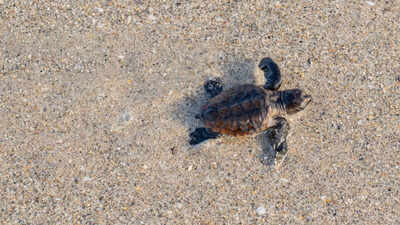
In September 2026, two olive ridley sea turtle nests were found on beaches in Southern California, marking the first confirmed instance of natural sea turtle nesting on the US West Coast. Now, after weeks of careful monitoring and incubation, some of the eggs have successfully hatched, allowing 54 hatchlings to return to the ocean.According to the US Fish and Wildlife Service, in its October 13, 2026, account of the discovery, the two nests were determined to have been laid by two different turtles. The young turtles were released near Seal Beach in the early hours of November 14, following their emergence at the Aquarium of the Pacific in Long Beach.The first of the two nests was discovered on September 16 at Seal Beach, followed by another on September 19 at Huntington Beach, around eight miles away.Olive ridley turtles are among the smallest species of sea turtles and are widely distributed across the Pacific, Indian and Atlantic Oceans. Their nesting populations are particularly prominent in countries such as Mexico, Nicaragua, Costa Rica and Panama. Before the California discovery, the northernmost known nesting location was in Baja California Sur, Mexico, approximately 700 miles south of Orange County.However, the reason for the turtles’ reappearance in Southern California is yet to be understood. Warmer ocean conditions have attracted attention, with an extreme marine heatwave and El Niño conditions being considered possible contributing factors in rising water temperatures. However, whether this represents a temporary occurrence or a more lasting change in their nesting range remains uncertain.
Why the eggs had to be moved
Although the discovery was encouraging, the nests were soon exposed to another challenge. With a tropical storm approaching the region, wildlife officials became concerned that high tides, hazardous surf and beach erosion could wash away the eggs before they had an opportunity to hatch.Following discussions between federal wildlife authorities and local conservation partners, a decision was made to relocate the eggs to a protected environment. On September 25, biologists carefully collected approximately 200 eggs from the two beaches and transferred them to the Aquarium of the Pacific in Long Beach, California.The Aquarium of the Pacific was entrusted with their care, given its long experience in looking after marine life and its rehabilitation efforts. Under its care, the eggs were placed in sand-filled containers in a secure, temperature- and humidity-controlled room at the aquarium’s Molina Animal Care Center. The staff closely monitored their environment.According to the Aquarium of the Pacific’s September 25, 2026, announcement, olive ridley eggs generally require somewhere between 45 and 60 days to incubate. The plan was to return any hatchlings to the beaches where their eggs had originally been laid, allowing them to undertake their first journey towards the ocean.
Fifty-four hatchlings finally make their way into the Pacific
After weeks of waiting, the first successful hatching brought some encouraging news. The eggs collected from Seal Beach began producing hatchlings on the evening of November 13, with the first tiny turtle emerging at approximately 7:15 p.m. By the end of the hatching process, 54 olive ridley turtles had successfully emerged. Aquarium staff and wildlife officials then carefully transferred them for their journey back to Seal Beach, where they were released close to the location of their original nest in the early hours of November 14.In its November 14, 2026, update, the Aquarium of the Pacific confirmed that the hatchlings had successfully reached the ocean. The release was coordinated with federal wildlife authorities and other conservation partners, with efforts made to minimise artificial lighting and human disturbance during the process.However, the 54 hatchlings were not the only eggs being monitored. The second clutch, collected from Huntington Beach, was also being cared for at the aquarium. In a subsequent development, another 21 olive ridley hatchlings from that nest were released at Huntington Beach on November 15, bringing the number of successfully released hatchlings from the two original nests to 75.While the successful release is an important conservation achievement, the hatchlings now face the difficult realities of surviving in the wild. According to the Aquarium of the Pacific’s November 14 update, the survival rate of olive ridley hatchlings is extremely low, with an estimated one in every thousand reaching adulthood. But for now, the appearance of the nests in California remains an unusual development whose longer-term significance is still being studied.