

Are you planning to buy gold on Dhanteras or Diwali this year? Buying precious metals such as gold and silver is seen to be auspicious during the festive season, but experts caution that investment decisions should focus on portfolio allocation.Within gold investment too, the choices are plenty and each carry their own tax implications.Fundamentally, what needs to be understood is that investors should first assess whether they require gold in their portfolio before investing in it. Although gold has outperformed equities recently, it has also corrected by around 22% from its January 2026 highs.Also Read | Gold price on Dhanteras: 60% return in 2025, 13% in 2026 – what’s the outlook for yellow metal for the next year?What are the factors to consider when making that investment decision? What are the various avenues of gold investment? What can you buy if not gold? We ask experts:
What should you do if you have Rs 10,000, Rs 50,000 or even Rs 1 lakh?
Gold is often used as a hedge against inflation and market uncertainty. However, it cannot replace equities as a core asset for long-term wealth creation, say experts.“If investors already have sufficient gold exposure, they should avoid adding more to their portfolio. Also, those with a higher than recommended allocation can gradually rebalance it towards diversified equity mutual funds,” says Jasmeet Singh, Executive Director, Anand Rathi Wealth Limited.Sadiya Khan, Chief Investment Solution officer at Mirae Asset Sharekhan says the starting point should be the investor’s objective.“For a retail investor looking to invest Rs 10,000, Rs 50,000 or Rs 1 lakh in gold, gold and gold mutual funds are generally more practical options for portfolio allocation, while coins and jewellery are better suited to physical ownership and gifting. Moreover with gold prices at current level of around Rs 15,000 per gram, an amount of Rs 10,000 or Rs 50,000 may not fetch a meaningful quantity for buying physical gold. This problem of size does not arise with Gold ETFs, gold mutual funds,” she tells TOI.
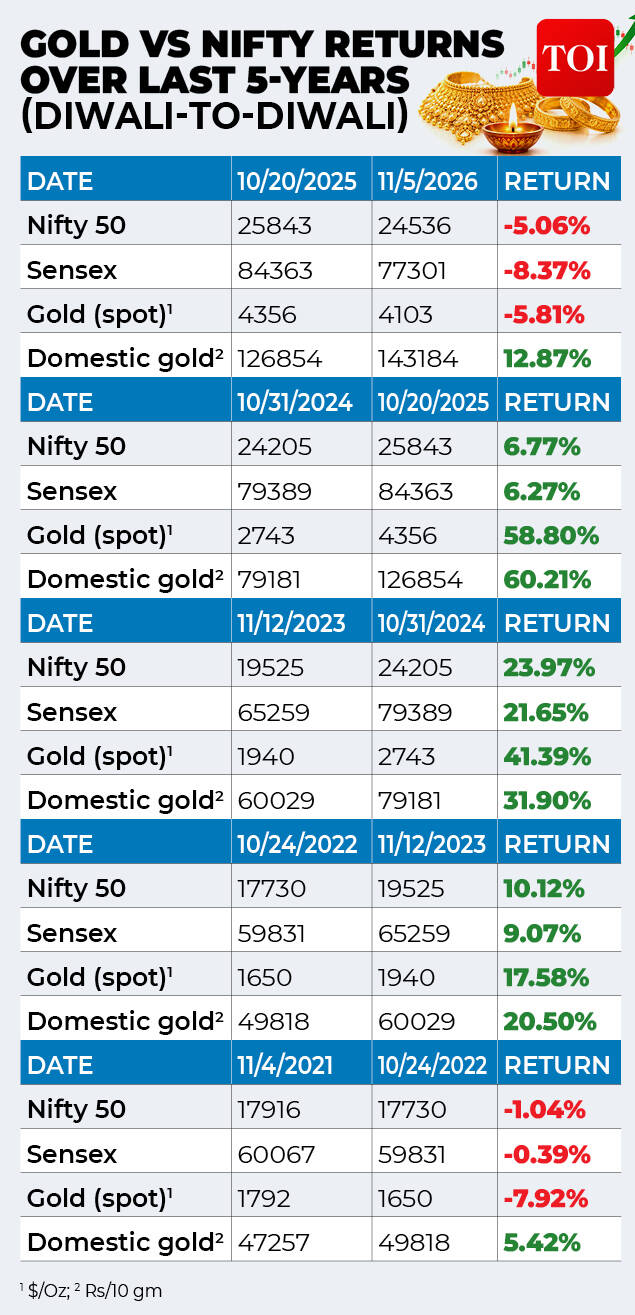
Gold vs Nifty Returns Over Last 5 Years (Diwali-to-Diwali)
Also, physical gold can involve significant upfront costs. Jewellery making charges can be particularly high, while coins and bars may also be sold at a premium to the prevailing gold value.“For Gold ETFs, investors should look beyond the expense ratio. Trading liquidity, tracking differences and the price at which the ETF trades relative to its indicative NAV can materially affect the actual purchase and sale price.Ultimately, investors should evaluate the total cost of ownership, liquidity, regulatory framework and ease of exit,” she says.“If an investor wants to buy gold for portfolio allocation purposes, Gold ETFs are a suitable option due to their relatively low-cost structure and ease of investment. If an investor wishes to own physical gold, gold coins and bars may be a better option than jewellery, owing to their lower making charges and higher purity and no adjustments made for usage wear and tear,” she adds.
Options to buy gold
Samit Guha, Managing Director & CEO, MMTC-PAMP notes that consumers today have several ways to buy gold, depending on whether they want physical ownership or a financial-product route.“Physical gold, in the form of jewellery, coins and bars, offers direct ownership and cultural value. Coins and bars add standardised denominations and assured purity, which makes them suited to festive gifting and long-term savings. They need safe storage, so buying from a trusted source matters,” he says.
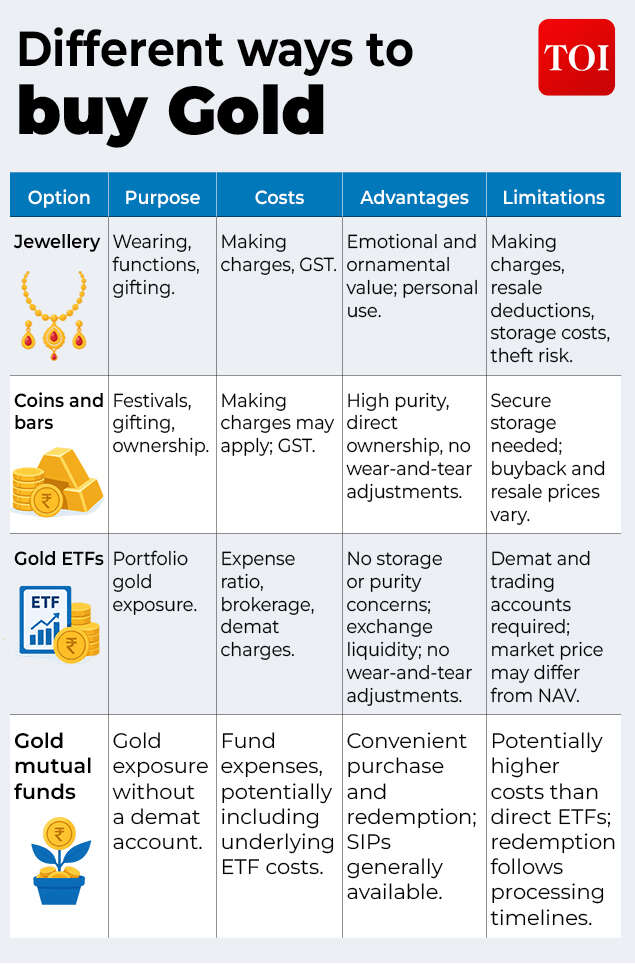
Different ways to buy Gold
“Gold ETFs are held in a demat account and bought and sold on the exchange. Gold mutual funds offer a similar financial-product route with no physical holding. Digital gold lets consumers build holdings through small, frequent purchases, often with an option to redeem into physical gold, subject to the platform’s terms,” he adds.There are several ways to invest in gold, not just physical gold.Physical gold: This includes jewellery, coins, and bars. These are usually a popular choice during Dhanteras. However, it’s important to remember that jewellery attracts making charges of around 6-25%, along with 3% GST on the total bill. Coins and bars on the other hand carry a smaller premium over the prevailing gold price.Gold ETFs and gold mutual funds allow you to invest in gold without buying or storing it physically. Gold ETFs invest directly in gold bullion, making them a preferred option for gold investment. They are traded on stock exchanges and require a demat account.Gold mutual funds invest in Gold ETFs, do not require a demat account and allow SIPs, but involve double expenses. However, Gold ETFs may trade at a premium to their underlying gold value, so investors should check the price before investing.Digital gold lets you buy gold online in small amounts, with the amount purchased stored in a vault by the provider. However, it is not regulated by SEBI, so it is important to check the credibility of the company offering it.Sovereign Gold Bonds (SGBs) are another option, with existing bonds available for purchase on stock exchanges. However, the government has not issued any fresh bonds since February 2024.The tax treatment also varies across these options. Physical gold, digital gold, and gold mutual funds attract long-term capital gains tax when held for more than 24 months, while for Gold ETFs this period is 12 months. Long-term gains are taxed at 12.5%, while short-term gains are taxed at the investor’s applicable income tax slab rate.
What to buy if not gold?
Analysts say that gold buying can often be driven by festive sentiment. It’s important to keep a tab on your overall portfolio mix to make sure it is balanced to meet your goals.According to Jasmeet Singh, long-term investors can consider an 80:20 equity-to-debt allocation.“The equity portion can be invested in actively managed, diversified equity mutual funds, in categories such as large cap, mid-cap, small-cap, large & mid cap, flexi-cap, multi-cap, dividend yield, and focused. The debt allocation can include arbitrage funds for investors in the highest tax bracket and target maturity funds for those in lower tax brackets. Investors can consider allocating half of their debt allocation, amounting to 10%, to Gold ETFs,” Jasmeet Singh says.As an alternative to gold, he recommends debt mutual funds.“Those in the highest tax bracket can consider arbitrage funds while those in lower tax brackets can opt for target maturity funds. These options can help investors preserve portfolio stability while keeping their equity investments focused on long-term wealth creation,” he advises.For Sadiya Khan, REITs (Real Estate Investment Trusts) and InvITs (Infrastructure Investment Trusts) make for a good alternative bet.REITs allow investors to own units in income-generating real estate assets, while InvITs provide exposure to infrastructure assets such as roads and power transmission projects, offering fractional ownership without buying the assets directly.“These instruments provide investors with tokenized and fractional ownership to real estate and infrastructure assets as an alternative to buying the underlying physical asset. These instruments can offer regular cash flows and portfolio diversification, however, they are subject to market risks, interest rate movements and fluctuations in asset performance,” she explains.
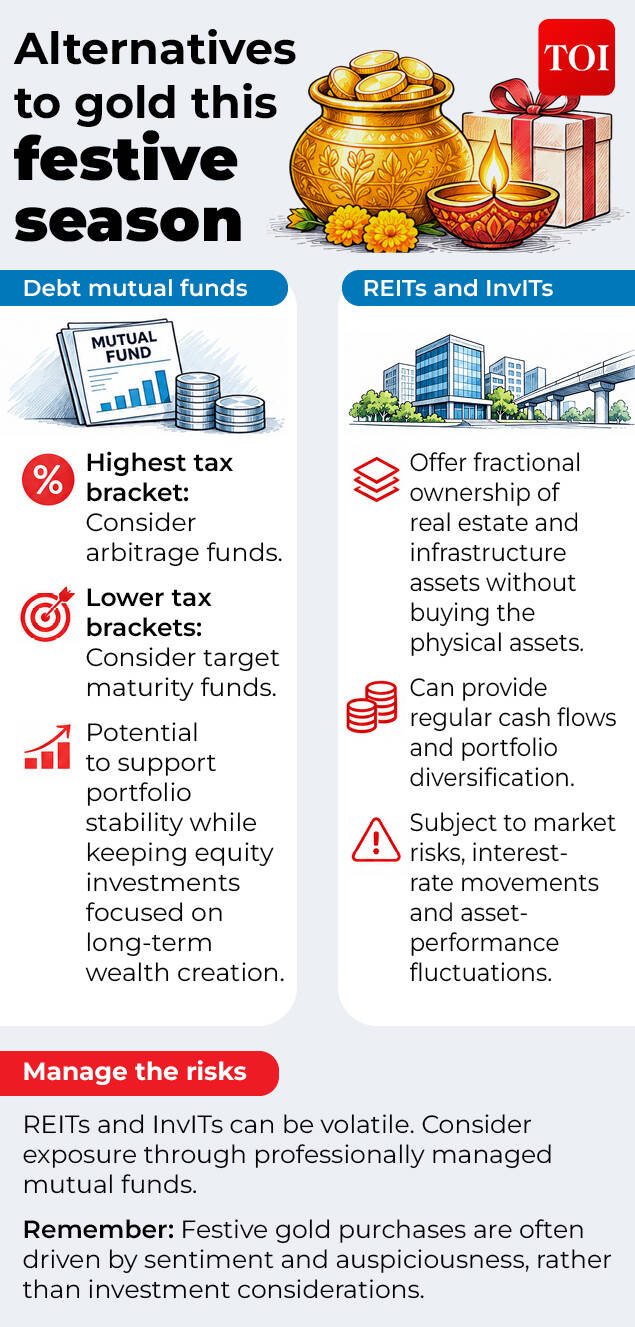
Alternatives to gold this festive season
“ReITs and InvITs can be volatile, and investors may consider exposure through professionally managed investment products such as mutual funds,” she cautions.She believes that apart from any physical gold requirement, from a portfolio allocation perspective, investors should consider allocating around 5% to 10% of their portfolio to commodities such as gold and silver.“Before determining portfolio allocations across asset classes such as equities, fixed income, gold, and silver, investors should assess their risk profile, investment objectives, investment horizon, and cash flow requirements, or seek expert advice to ensure that their investments are aligned with their financial goals,” she says.“Further, investment in gold must be considered for hedging purposes rather than return generation,” she adds.(Disclaimer: Recommendations and views on the stock market, or any other asset classes or personal finance management tips given by experts and analysts are their own. These opinions do not represent the views of The Times of India.)