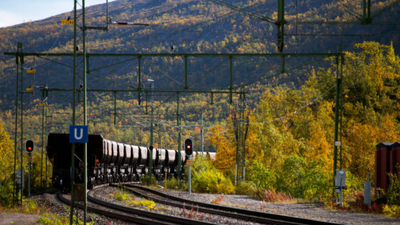
For more than 150 years, a reported 16-minute train delay in Exeter, England, was cited as a possible early example of a solar storm disrupting human technology. But a railway timetable revealed a problem with the story: the railway line in question did not exist in 1841. According to a report published by ScienceDaily on October 21, 2026, researchers have now traced the incident to October 18, 1848, using historical railway records, newspaper accounts and measurements of Earth’s magnetic field. The findings were published in the journal Space Weather.
The train delay that could not have happened in 1841
The mystery originated in an account published anonymously in the scientific journal Nature on October 5, 1871. It described a “very intense magnetic disturbance” on October 18, 1841, which allegedly interfered with railway telegraph equipment in Exeter, a city in southwest England. According to the account, the disturbance prevented railway staff from establishing whether the track ahead, near the village of Starcross, was clear. As a result, the scheduled 10.05 pm express train from Exeter towards Newton Abbot was held up for 16 minutes.The report also described how the railway superintendent initially suspected that someone was tampering with the instruments because they would not function properly. The incident later attracted scientific interest because it appeared to document solar activity interfering with electrical infrastructure decades before modern power grids and satellite networks existed.However, the timeline did not withstand closer scrutiny. Researchers found that the railway section connecting Exeter with Starcross opened only on May 30, 1846, almost five years after the supposed incident. The line reached Newton Abbot later that year.The discrepancy prompted scientists to investigate whether the original report contained an incorrect date. The British Geological Survey (BGS), which participated in the international research effort, said the team compared railway timetables, historical newspapers, solar observations, aurora reports and digitised geomagnetic records.
Why researchers believe the incident happened in 1848
The evidence pointed to October 18, 1848, rather than October 18, 1841. Researchers examining historical railway timetables found that a 10.05 pm departure from Exeter towards Starcross was scheduled during a period spanning March 1848 to July 1849. That made October 1848 a plausible date for the reported delay.More importantly, historical magnetic measurements showed strong geomagnetic activity on October 18, 1848. Records preserved in the Greenwich Observatory archive documented significant changes in Earth’s magnetic field around the time of the alleged incident. Reports of sunspots and auroras observed across Britain and Europe offered additional evidence of heightened solar activity.The researchers concluded that the combination of railway records and magnetic observations strongly supported the revised date. The original account, published three decades after the event, appears to have contained a typographical error.The study, titled ‘Did Space Weather Delay the 10:05 p.m. Train Departure From Exeter on 18 October 1841?’, was led by James A. Wild of Lancaster University. Its international team included researchers from the British Geological Survey, RMIT University, Natural Resources Canada, Baylor University and RAL Space in the UK.The researchers could not recover the original source material behind the 1871 account, so the precise circumstances cannot be established with absolute certainty. Their conclusion is that the train delay most likely occurred in 1848, not that every detail of the original story has been independently confirmed.
What is a solar storm, and how can it affect a railway?
Space weather refers to changes in the environment around Earth caused by solar activity. The Sun can produce eruptions that send charged particles and magnetic fields into space. When these disturbances interact with Earth’s magnetic environment, they can trigger geomagnetic storms.Such storms can generate unwanted electrical currents in long conductors, including wires used by telegraph networks. In the 1840s, railways were beginning to rely on electric telegraphs to communicate between signal stations and establish whether sections of track were occupied or clear.These systems helped railway workers coordinate train movements across distances. If magnetic disturbances interfered with the telegraph equipment, staff could struggle to establish the status