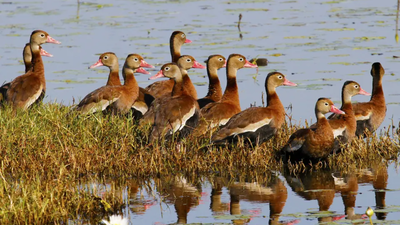
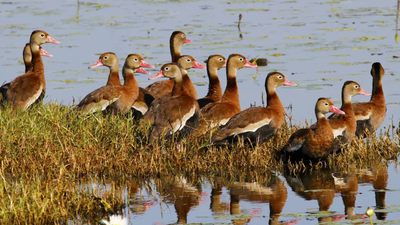
Black-bellied whistling ducks, once largely confined to a few counties in South Texas, now breed in 90% of Texas counties as their range expands across the United States. Native to Mexico, Central America and South America, the tropical birds have spread along the Gulf Coast, up the Eastern Seaboard and across the Midwest. Researchers point to milder winters, changing rice-growing patterns and the species’ exploratory behaviour as possible factors behind this expansion. However, the exact reasons remain uncertain. The growing population has also raised wildlife management and agricultural concerns, particularly in Louisiana, where rice farmers have reported damage caused by the birds.
How black-bellied whistling ducks expanded their range across Texas
According to the Houston Chronicle, Black-bellied whistling ducks are native to Mexico, Central America and South America. Their historical range in the United States was largely restricted to a few counties in the Rio Grande Valley, on the northern edge of their distribution. The species was first recorded in South Texas during the Audubon Society’s 1959–60 Christmas Bird Count. Its subsequent expansion has transformed it from a bird with a limited presence in the state into a widespread breeding species.An important part of this change to population increases followed decades of suppression. Ringelman said the birds’ numbers had been affected from the 1940s through the 1970s by the widespread use of organochlorine pesticides, including DDT, which was banned in 1972. These chemicals were harmful to ducks, particularly black-bellied whistling ducks, which depend on agricultural grains as part of their diet. Numbers began increasing after this period, and Texas added the species to its duck-hunting season in 1983. The population subsequently grew rapidly after the turn of the millennium.
How whistling ducks expanded across 90% of Texas counties
The scale of the species’ expansion is reflected in its present breeding distribution. Kevin Kraai, waterfowl programme leader at the Texas Parks and Wildlife Department, told the Houston Chronicle: “They’re now breeding in 90% of the counties in the state of Texas.” This marks a substantial change from the bird’s earlier concentration in the southernmost part of the state.Historical observations also indicate the species’ capacity to reproduce successfully in Texas. In his 1976 book Ducks, Geese and Swans of North America, waterfowl researcher Frank C. Bellrose recorded that the age ratio in the autumn population of black-bellied whistling ducks in 1963 was one adult to 3.9 young. He described this as “a much higher ratio than those found for other species of ducks”. Bellrose added: “If such production prevails over a period of years, the species should prosper in Texas.” His book also noted that approximately 3,000 black-bellied whistling ducks bred in lower coastal Texas in 1974.The birds’ distribution now extends well beyond Texas. They can be found along the Gulf Coast, up the Eastern Seaboard and across the Midwest. Memphis appears to support the northernmost sizable breeding population, while individual birds have been recorded in Canada as far as Nova Scotia, New Brunswick and Newfoundland. These observations demonstrate the species’ presence across a wider geographical area, although isolated sightings do not necessarily indicate established breeding populations.
Why ducks are expanding their range northward
Researchers have identified several possible explanations for the northward expansion, although the precise causes remain uncertain. Ringelman told the Houston Chronicle: “Lots of potential reasons, none of which we can really point to as a smoking gun.” He noted that the species’ tropical origins make warmer conditions potentially beneficial, particularly as winters become milder in regions farther north.Ringelman explained: “Certainly as a largely tropical species, they like warm weather. And so with climate change, winters are becoming milder, and they’re able to persist over winter periods in regions further north.” Changes in agricultural practices as a possible contributing factor. Rice cultivation has shifted into other parts of the United States, while longer growing seasons and cold-tolerant rice varieties have helped provide a dependable food source for the birds in these areas. However, the article does not establish any single factor as the definitive explanation for the expansion.The ducks’ behaviour may also contribute to their ability to colonise new areas. Ringelman described them as an exploratory species that tends to remain in places where it establishes itself. Research conducted by his laboratory at Louisiana State University used tracking devices to investigate whether birds in Louisiana migrated elsewhere during winter or remained in the state. According to Ringelman, the findings showed that the tracked birds stayed in Louisiana throughout the year. Their status as year-round residents could provide a base from which younger birds disperse and establish populations in new locations.Ringelman said young birds could be central to the expansion, although he emphasised that this aspect of their ecology requires further study. Researchers are also interested in understanding why some individuals venture farther from their original range than others and whether particular behavioural characteristics help them establish populations in new locations. The distinction between dispersing into new territory and establishing a lasting population remains an important question in understanding the species’ spread.
Black-bellied whistling ducks attract hunters
The expanding population has attracted interest from waterfowl hunters. Louisiana has introduced an experimental October hunting season targeting black-bellied whistling ducks, scheduled to continue through 2029. Hunters in Texas, Louisiana and other states can also hunt the species during the regular duck season. However, the available figures do not provide a definitive estimate of the total black-bellied whistling duck population in Texas.Louisiana’s midwinter survey indicated a population of around 140,000 birds in the state, but wildlife officials described that figure as conservative. Jason Olszak, waterfowl programme manager at the Louisiana Department of Wildlife and Fisheries, explained that the survey did not cover some areas of urban New Orleans and Baton Rouge where large numbers of the birds congregate. He said: “So, it’s definitely a conservative estimate.” The Houston Chronicle also cited an article published a decade earlier that reported estimates suggesting as many as 75% of the black-bellied whistling ducks nesting in the United States were in Texas.
How expanding black-bellied whistling duck populations affect rice farmers
The growing population has also created problems for some agricultural operations in Louisiana. Birds congregating in large numbers at grain elevators along the Mississippi River can pose food-safety hazards, while rice farms have experienced crop damage. They can also remove vegetation along the banks of ponds in residential areas and urban parks. A 2024 report from the LSU AgCenter indicated that rice farmers in Louisiana had spent $3 million because of damage caused by black-bellied whistling ducks.The expansion has prompted concerns about the possibility of similar agricultural impacts elsewhere. Ringelman, who is based at the University of California, Davis, has highlighted the potential implications for rice-growing areas in California’s Central Valley if the birds establish themselves there. He told the Houston Chronicle: “Here’s an example of potentially an emerging concern for rice farmers in California. Because if these birds ever got to California and discovered all the rice here, they would have a field day. And they could certainly be here year-round.”Despite the species’ growing range, important questions remain about its population structure and how best to manage it. Ringelman has expressed interest in determining how closely connected populations in Texas, Louisiana, the ACE Basin and Memphis are, and whether they form one large population or several separate ones. Such information would help wildlife managers understand which populations are affected by hunting and how management decisions might influence them.