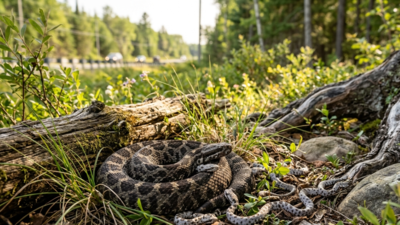
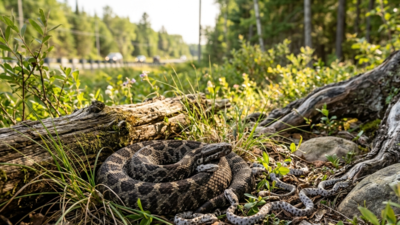
The death of a rattlesnake on a road in Windsor, Ontario, last year could have been a serious setback for an already fragile local population. But the male snake Gordo, had mated before he was found dead, leaving behind a possibility that conservation workers had been hoping for. His mate, a female Eastern Massasauga rattlesnake called Ashley, later gave birth to seven young at Toronto Zoo. The babies are now being raised under human care, with plans to return them to the wild once they are old enough. Their arrival could help preserve a rare genetic line in one of Canada’s most threatened snake populations.
Eastern Massasauga rattlesnake Gordo’s role in Windsor conservation effort
Gordo was part of a conservation effort aimed at rebuilding the Eastern Massasauga rattlesnake population in the Ojibway Prairie Complex in Windsor-Essex. The male had been raised to adulthood at Toronto Zoo before being introduced to the local habitat. His ancestry also had a connection to the region, tracing back to Eastern Massasaugas rescued in LaSalle more than 25 years ago.In September 2025, his body was discovered on Matchett Road, with evidence suggesting that he had been struck by a vehicle while attempting to cross. The conservation team was able to identify him through an electronic transmitter implanted in his body, which had been used to monitor his movements after release.His death was particularly concerning because the local population was already struggling to survive. Jonathan Choquette, a biologist with a PhD who leads Wildlife Preservation Canada’s Ojibway Prairie Reptile Recovery programme, has warned that the number of Eastern Massasaugas remaining in Windsor-Essex could be fewer than 10, as reported by CBC News.
Toronto Zoo raises seven Eastern Massasauga rattlesnake babies for wild release
Before Gordo died, he had successfully mated with a female known to the conservation team as Ashley. The team knew about the pairing, but confirmation that it had resulted in offspring came several months later.Ashley was taken to Toronto Zoo earlier in 2026 to have her transmitter implant replaced. During the procedure, an X-ray revealed that she was carrying eggs. Eastern Massasauga rattlesnakes reproduce differently from many other reptiles. They are ovoviviparous, which means the eggs develop and hatch inside the mother’s body before the young are delivered through live birth.Ashley subsequently gave birth to seven baby rattlesnakes at the zoo earlier this spring. The young snakes are now being cared for in captivity while conservation specialists prepare them for a possible return to their natural habitat.For Choquette, their arrival has a direct connection to the wider recovery effort. Speaking to CBC News, he said the babies carry Ojibway genetics, making their survival particularly relevant to the future of the local population.
Why the Windsor-Essex population needs intervention
Eastern Massasauga rattlesnakes are native to Ontario, but their numbers have declined across much of their former range. In Windsor-Essex, the species is now close to disappearing locally, with estimates suggesting that fewer than 10 individuals may remain.They are also the only venomous snake species native to Ontario and are classified as critically endangered in the province. Despite their reputation, the snakes generally avoid human contact. According to Ontario Nature, they tend to retreat or use their distinctive rattle as a warning when disturbed. Biting is generally a last response when they feel threatened.The loss of individual snakes can have serious consequences for such a small population. Choquette has explained that the remaining numbers are not sufficient to sustain a viable population without deliberate conservation work and the introduction of additional individuals.Gordo had been selected as a breeding male as part of that effort. His death meant the team lost an individual that could have contributed to future generations in the wild. Ashley’s pregnancy, followed by the birth of seven young, has provided another opportunity to strengthen the population.
A return to the Ojibway Prairie Complex is planned
The seven offspring will not be released immediately. They are expected to remain under care until they reach the age of one year, giving them time to develop before being introduced to the natural environment. If they progress as planned, conservation workers hope to release them into the Ojibway Prairie Complex in the summer of 2027.The location is significant beyond its role in the breeding programme. According to Choquette, it supports the only tallgrass prairie population of Eastern Massasauga rattlesnakes in Canada. This makes the habitat an important part of the country’s natural heritage, as well as a priority for local species recovery.The planned release will also give the young snakes an opportunity to contribute to the same population Gordo was brought in to support. While his death on Matchett Road ended his time in the wild, the seven offspring offer a chance for his genetic line to remain part of Windsor-Essex’s native rattlesnake population.