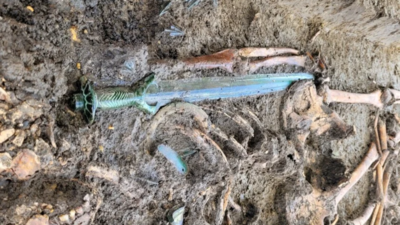
A 3,400-year-old bronze sword unearthed in Nördlingen, Swabia, in 2023 has been examined at Helmholtz-Zentrum Berlin using three non-destructive methods. The Bavarian State Office for the Preservation of Historical Monuments sent the Middle Bronze Age artefact to Berlin with specific questions. CT scanning showed the blade was clamped into the hilt with a tang and riveted. X-ray fluorescence at BESSY II found that the decorative inlay on the pommel consisted of copper wires, not the tin one the restorer expected. Internal stress analysis also probed the manufacturing processes. The experts now plan to publish their full results after evaluating the data.
X-ray scans reveal how the bronze sword was made
The researchers went to Berlin with specific questions. “We had specific questions that we wanted to investigate using three different methods at HZB, and with the help of BAM,” says Tolksdorf. Herbold explains: “Such swords were very costly to manufacture. We wanted to find out how the handle was connected to the blade at that time and how the decorative patterns were incorporated at that time.” The question of the connection was examined in the HZB computer tomography laboratory, where Dr Nikolay Kardjilov and his team created a three-dimensional X-ray image of the sword.According to Tolksdorf, the scan answered the question. “The CT scan shows that the blade was clamped into the hilt with a tang, i.e. an extension of the blade, and riveted,” he says. He adds that the resolution is high enough to examine the material and the traces of the decorative work. The experts were thus able to determine how the hilt and blade are connected, according to the release.
Scientists find copper wires where they expected tin
According to a press release from the Helmholtz-Zentrum Berlin, the pommel and pommel plate are adorned with deep grooves that form a geometric pattern. These grooves contained what appeared to be a different material, and it remained unclear what it was. The team investigated further at the BAMline at BESSY II, which is operated by BAM. Dr Martin Radtke examined the sword using X-ray fluorescence spectroscopy. “We irradiate the surfaces on the pommel with intense synchrotron radiation. This excites atoms in the material, causing them to emit element-specific X-rays, which we then measure,” Radtke says. He adds: “We can detect even the tiniest traces of elements.”The initial results show that the inlay work on the pommel and pommel plate consisted of copper wires that were pieced together. Herbold says she had expected something else: “Based on its appearance, I actually expected tin to have been used for these decorations, as tin is softer and easier to work with than copper, so that was a surprise, which also shows how highly developed craftsmanship was even back then.” Traces of tin and, in some places, a little lead were also detected, which probably came from the bronze alloy. Tolksdorf says this type of copper-wire inlay in bronze is known from other finds. He suggests that, to make the reddish copper stand out from the gold-coloured bronze, it may have been patinated, that is, chemically blackened, for example with urine.
X-ray analysis reveals Bronze Age metalworking techniques
The question of how the craftsmen worked was examined in Dr Manuela Klaus’s X-ray laboratory, where an internal stress analysis can detect pressure and tension in the crystalline surfaces. “This provides information about the manufacturing processes, because typical changes to the crystalline structures occur during heating, quenching, casting, hammering and forging,” says Klaus. According to the release, the experts have gained valuable insight into the craft techniques employed in southern Germany during the Bronze Age.The evaluation of the measurement data will take some time, after which the experts plan to publish their results and conclusions. Tolksdorf says the team hopes to determine whether the sword was made in a specific workshop. So far, they can only assume that it was manufactured in southern Germany, one of the two main areas where octagonal swords were prevalent in the Bronze Age in Germany. Prof. Mathias Pfeil, General Curator of the BLfD, says: “Using state-of-the-art measurement methods, we can understand how metal was worked almost three and a half millennia ago, with astonishing precision and highly developed skills.” He adds that the scientific examination makes the find even more significant, as only then does “a fascinating find become a valuable source of knowledge”.