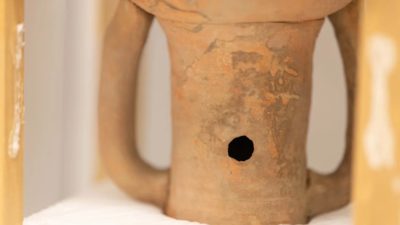
Scientists analysing a 2,000-year-old Egyptian jar have discovered traces of wine, opium and potentially dozens of plants, including toxic species with hallucinogenic properties. The ancient ceramic vessel, excavated from a Nubian tomb in southern Egypt, contained chemical residues that could point to a complex medicinal or ritualistic preparation. Researchers at Yale University’s Peabody Museum found signatures associated with belladonna and henbane, alongside wine and opium. The findings have also raised comparisons with ancient remedies mentioned in historical texts, including theriac and nepenthe. The discovery offers fresh evidence of how plants and psychoactive substances may have been used in ancient societies.
2,000-year-old Egyptian jar discovered in Nubian tomb
According to Yale News, a ceramic vessel, identified as an amphora, was originally excavated in Arminna, an ancient Nubian settlement in southern Egypt. It was recovered during archaeological expeditions led by Yale Egyptologist William Kelly Simpson in the early 1960s. The excavations were part of an international effort to preserve archaeological remains threatened by the construction of the Aswan Dam. Simpson and his team recovered numerous artefacts, including buildings, funerary inscriptions and objects associated with different periods of Nubian history. The amphora was among the objects subsequently housed in Yale’s Peabody Museum.Amphorae were widely used across the Greco-Roman world to store and transport commodities such as wine and olive oil. However, this particular vessel attracted Koh’s attention because of its unusual size and a small circular hole drilled into one side of its neck, a few inches below the mouth. It was larger than containers commonly used for valuable substances such as perfume or opium but smaller than amphorae typically used for transporting wine. Explaining his observations, Koh said, “It’s shaped for transporting wine but doesn’t have the volume one typically finds. It wouldn’t make great economic sense to trade standard wine in such small amounts. The clues suggested that it must have served some more specialised purpose.”
Scientists find wine, opium and toxic plants inside the jar
Researchers examined residues that had remained trapped at the bottom of the amphora for thousands of years. Some of the material was still visible inside the vessel. Laboratory tests identified chemical biomarkers associated with wine, opium and potentially dozens of other plants. Among the plants indicated by the chemical signatures were belladonna and henbane, both members of the nightshade family. These plants are toxic and have hallucinogenic properties, and have historically been associated with medicinal and ritualistic uses.The combination of substances suggests that the contents may have been more complex than ordinary wine. According to the Yale research, the chemical signatures indicate that wine could have been used as a medium to dissolve the other ingredients rather than simply being preserved with additional substances. The researchers have not yet identified every ingredient in the mixture, and further interdisciplinary investigations are needed to establish the full composition. The findings nevertheless provide evidence of a preparation containing several different plant-derived substances, including ingredients associated with ancient medicinal practices.
Ancient potion compared to remedies from Greek history
The chemical signatures found inside the amphora have drawn comparisons with two preparations known from ancient historical and literary accounts. One is theriac, an ancient antidote that was used to treat a variety of illnesses. The other is nepenthe, a medicinal substance mentioned in Homer’s Odyssey and associated with treating sorrow through forgetfulness. Researchers have suggested that the mixture could have belonged to a similar category of ancient preparations, although its precise purpose and complete composition have not been established.Koh said that the findings pointed towards a preparation with a purpose beyond ordinary consumption. Explaining the possible nature of the mixture, he said, “It quite likely was a potion that served a deeper cultural purpose we are only beginning to understand.” He also emphasised that the chemical evidence was consistent with an unusual preparation, adding, “I’m confident it was in that genre — unusual vessels often held unusual contents.” The researchers stressed that more work would be required to identify the different ingredients and understand how the preparation was used.
Yale researchers uncover more clues about ancient Egyptian plants
The latest findings build on earlier research conducted by the Yale Ancient Pharmacology Program. Researchers identified chemical traces of opium in an ancient Egyptian alabaster vase that Koh had encountered in Yale’s Babylonian Collection. That discovery suggested that the use of opiates may have been more common in ancient Egyptian culture than previously understood. The examination of other ancient vessels recovered from Egypt has also revealed potential chemical signatures of numerous plants, including Egyptian blue lotus, a water lily belonging to the Nymphaeaceae family with psychoactive properties.The research into blue lotus is continuing through a partnership between YAPP and Yale’s Marsh Botanical Garden, where researchers are cultivating a specimen donated by a colleague at the University of Connecticut. Koh explained that the plant had an important place in ancient Egyptian mythology and ritual practices. “Blue lotus was a prominent plant in ancient Egypt steeped in mythology and ritual, connected to creation, rebirth, and life,” he said. He added that ancient Egyptian artwork depicted people inhaling and consuming the plant, while historical texts described its use in healing and sacred wines. Researchers hope that further examination of ancient materials will provide additional evidence about the plants used in historical preparations.The Peabody Museum’s collection continues to provide researchers with access to archaeological objects that have not yet been extensively studied. Sarah Clunis, head of anthropology collections at the museum, said that making these materials available to scholars was an important part of caring for the collection. “Access to these objects is a top priority,” she said. She added that artefacts such as the amphora could help researchers understand ancient people’s religious rituals and the medicines they used to treat physical and mental ailments.