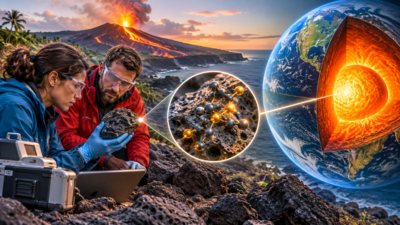
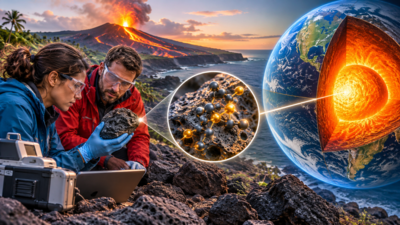
Scientists may have uncovered a 4.5-billion-year-old secret hidden deep inside Earth after discovering an unusual carbon signature in volcanic rocks from Hawaii. The finding suggests that carbon has been escaping from the planet’s core into the surrounding mantle, offering a rare glimpse into Earth’s inaccessible interior. Researchers analysed tiny pockets of molten rock trapped inside volcanic crystals and found a chemical signature unlike that normally associated with the mantle. According to the study published in the journal Proceedings of the National Academy of Sciences, titled ‘Isotopically heavy carbon in the core’, this could also help explain where Earth’s carbon came from, pointing to carbon-rich meteorites from the outer Solar System.
Hawaiian lava reveals an unusual carbon-13 signature
The international research team analysed carbon isotopes in melt inclusions from Hawaiian volcanic lavas. These tiny pockets of molten material become trapped inside growing crystals before magma reaches the surface. Because the samples were preserved before significant gas loss, they allowed researchers to investigate carbon signatures that might otherwise have been altered during volcanic activity.High-precision measurements of carbon-13, a naturally occurring heavier form of carbon. The researchers found that melt inclusions from shield-stage lavas had a carbon isotope signature of -1 ± 2 per mille (‰). This differed considerably from the -7 ± 2‰ signature recorded in rejuvenated-stage lavas, which reflected a more typical mantle composition.
Unusual carbon signature points to Earth’s core–mantle boundary
The researchers linked the unusual carbon signature in shield-stage lavas to the deeper part of the Hawaiian mantle plume. These lavas are interpreted to sample material from the plume’s central axis, which is thought to originate near the core–mantle boundary, the region separating Earth’s metallic core from its rocky mantle.By contrast, rejuvenated-stage lavas were interpreted to originate from mantle material drawn into the outer parts of the plume. Their carbon isotope measurements were consistent with the normal mantle signature. The contrast between the two groups of volcanic samples led the researchers to propose that the unusually carbon-13-rich material had received carbon from Earth’s core. In the paper’s significance statement, the authors explain: “We interpret this as the fingerprint of carbon transferred from the core into the mantle.” This interpretation suggests that carbon has been exchanged between the planet’s deepest interior and the surrounding mantle, potentially providing a way to investigate the composition of a reservoir that has remained inaccessible to direct observation.
Volcanic rocks provide new evidence of carbon exchange deep inside Earth
The findings are particularly important because Earth’s core is believed to contain the majority of the planet’s carbon. However, determining its precise composition has been difficult because scientists cannot directly collect samples from this extreme-depth environment.The researchers argue that the carbon isotope measurements provide a constraint on the core’s previously unknown carbon signature. The shield-stage melt inclusions point towards a primary carbon isotope composition of -1 ± 2‰, which the team interprets as evidence of carbon exchange between the core and mantle. The rejuvenated-stage samples, meanwhile, retain the more familiar mantle signature of -7 ± 2‰.The study therefore offers a new way to investigate the distribution of carbon inside Earth. Rather than relying solely on surface rocks or indirect estimates of deep planetary reservoirs, scientists can use volcanic material brought up by mantle plumes to examine chemical signatures originating from much deeper within the planet.
Carbon-rich meteorites may have delivered Earth’s original carbon
Beyond revealing a possible exchange of material between Earth’s core and mantle, the findings also address a long-standing question about the origin of the planet’s carbon. The researchers’ results point towards carbonaceous chondrites, a type of meteorite rich in carbon-bearing material, as the primary source of Earth’s carbon.These meteorites are associated with the outer Solar System. According to the study, carbon-rich material from these primitive planetary building blocks was delivered to Earth during the final stages of its formation. Their isotopically heavy carbon signature is consistent with the composition inferred from the Hawaiian volcanic samples. The discovery offers a way of understanding the origin of Earth’s volatiles and provides a new constraint on the carbon composition of its core. Although the proposed transfer of carbon from the core into the mantle is an interpretation of the isotope evidence, the results offer a rare glimpse into the chemical history of Earth’s deepest interior.