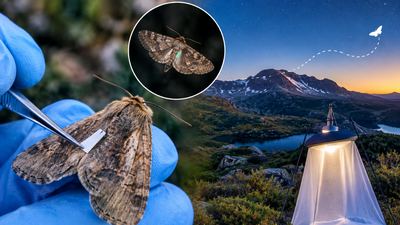
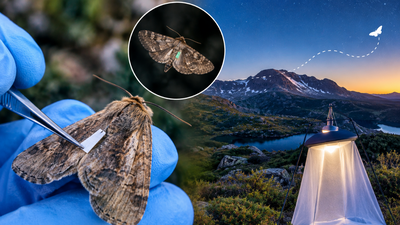
More than 14,000 Bogong moths were tagged in an unusual attempt to uncover the secrets of one of Australia’s most remarkable insect migrations. Researchers marked the endangered moths in the Snowy Mountains and hoped to track where they travelled after leaving their summer shelters. Some were marked with non-toxic paint, while others were fitted with tiny paper tags attached to their wings. According to ABC News, volunteers released the tagged moths around Mount Kosciuszko and used light traps to look for them as they moved through the region. Yet, despite the large number of insects tagged, not a single one has been found so far. Researchers say that may not necessarily mean the project failed. The absence of tagged moths could indicate that the population is larger than expected or that the insects are following a different migration route.
A mysterious annual migration
Bogong moths are known for undertaking one of Australia’s most remarkable insect migrations. Every year, billions of these peanut-sized moths travel to the cooler regions of the New South Wales Snowy Mountains, including the caves around Mount Kosciuszko, to escape the heat. When conditions change, the moths leave their mountain shelters and travel thousands of kilometres back towards inland areas where they breed. However, scientists still do not have a complete picture of exactly where the moths go or which routes they use.That uncertainty is particularly important because Bogong moths have experienced a dramatic decline. Their population fell by as much as 99.5 per cent during a major crash in 2017 associated with drought and climate change. The species was listed as endangered in 2021. Researchers from Western Sydney University and Invertebrates Australia launched the tagging project to gain a clearer understanding of the moths’ movements and help improve conservation efforts.
Tiny tags and eyelash glue
In February, researchers tagged more than 14,000 Bogong moths in caves at Mount Kosciuszko. The process was delicate because the insects are small and need to remain capable of flying normally after being released. Some moths were marked with small amounts of non-toxic paint. Others were temporarily sedated with carbon dioxide so researchers could attach tiny paper tags to their wings using eyelash glue. The procedure was designed to allow scientists to identify individual moths if they were encountered later during their migration.The researchers then recruited citizen scientists to help locate the marked insects. Fifty specially designed light traps were installed around the mountains. The traps attract moths at night and hold them safely so volunteers can check them for identifying marks before releasing them. But despite the effort, the result has been surprising: none of the more than 14,000 tagged moths has been found again. For volunteers, the search has meant checking moths regularly and looking closely for the tiny markings. One participant, Kristi Bryant, compared finding a tagged moth to discovering a “golden ticket” because of how rare the marked insects have proved to be, according to ABC News.
Missing moths offer clues
At first, failing to find even one tagged moth might sound like a major setback. Researchers, however, believe the result could contain an unexpected positive message. Eleanor Drinkwater, an entomologist with Invertebrates Australia, explained that the likelihood of finding a tagged individual depends partly on the size of the wider population. If there are more Bogong moths than scientists currently estimate, locating one particular tagged insect becomes much more difficult.Another possibility is that the moths are taking migration routes that do not pass through the monitoring sites. In other words, the missing tags could reveal that scientists still have more to learn about how the insects move across the landscape. The project has also produced useful information even without recovering a single tagged moth. iNaturalist data show a significant increase in untagged Bogong moth sightings, with more than 2,700 recorded in the past year. Researchers plan to use these observations to create heat maps showing where the moths are appearing across the alpine landscape. They will also compare the observations with weather patterns to investigate whether environmental conditions influence the insects’ movements.
The search continues
Researchers hope to expand the monitoring programme from 50 light traps to as many as 150 next year. The additional traps could provide a wider picture of where Bogong moths are travelling and potentially increase the chances of finding one of the tagged insects. For now, the fate of the 14,000 tagged moths remains a mystery. But their disappearance may offer scientists an unexpected clue: the endangered insects could be more widespread than previously believed, or they may simply be travelling along routes that researchers have yet to discover.Either way, the project is providing researchers with valuable information about a species whose movements remain surprisingly difficult to track. Understanding those movements could ultimately help scientists better protect Bogong moths and the ecosystems that depend on them.