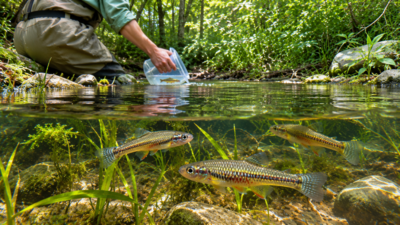
An endangered fish native to Tennessee has returned to a wildlife refuge more than 15 years after its population disappeared following the arrival of an invasive species. Conservationists released Barrens topminnows (Fundulus julisia) at three recovery sites on November 4, 2026, marking a significant development in efforts to save one of the state’s rarest freshwater fish. At the Vervilla Tract in the Tennessee National Wildlife Refuge, a flood had allowed western mosquitofish, introduced to the region decades earlier for mosquito control, to enter the habitat and eliminate the native population. After restoring the site and removing the invasive fish, conservation partners have now reintroduced the endangered species, increasing its known populations from six to nine.
A fish introduced to control mosquitoes became a threat to Tennessee’s native species
The western mosquitofish (Gambusia affinis) was introduced to the Barrens Plateau during the mid-20th century as a biological method of controlling mosquito populations. The idea was to use the fish to feed on mosquito larvae and reduce the insects’ numbers.However, the introduction had unintended consequences for the region’s aquatic ecosystem. Although western mosquitofish are native to parts of Tennessee, they do not naturally occur on the Barrens Plateau, where the endangered topminnow is found.The invasive fish prey on Barrens topminnow eggs and young, while also harassing juvenile and adult fish. They compete for suitable habitat and reduce the native species’ chances of surviving and reproducing.According to the US Fish and Wildlife Service (USFWS), the arrival of western mosquitofish at a Barrens topminnow site has generally resulted in the native population disappearing within three to five years.
A flood wiped out the population at the Vervilla Tract
The Vervilla Tract, part of the Tennessee National Wildlife Refuge, was acquired specifically to support the recovery of the Barrens topminnow. The site had supported a thriving population for several years.More than 15 years ago, however, a major flood overtopped a water-control structure, allowing western mosquitofish to enter the habitat. Their presence ultimately eliminated the topminnow population at the property.The species had not been recorded at Vervilla for more than 15 years before the latest reintroduction.In 2026, the Partners for Fish and Wildlife Program, Tennessee Wildlife Federation and Tennessee Wildlife Resources Agency worked on restoring the habitat and removing the invasive mosquitofish. Once the restoration work was completed and the invasive fish were successfully removed, the site was considered suitable for the native species to return.On November 4, conservationists released Barrens topminnows into the restored waters, marking their return to the property.
Three new populations increase the known total to nine
The November 4 releases took place at three recovery sites across Tennessee. Before the intervention, the endangered species was known to have six populations. The establishment of three additional populations increased that number to nine.Two of the release locations were particularly important for the Elk River Evolutionarily Significant Unit, a genetically and historically distinct group of populations.Before the latest releases, only one known Barrens topminnow population survived within this group. Establishing additional populations provides another safeguard against the loss of this distinct genetic lineage.The USFWS said the new populations represent progress towards protecting the species across its native range. However, the releases are part of a longer recovery programme, and the fish remains endangered.
Why the Barrens topminnow is found only in Tennessee
The Barrens topminnow is a small freshwater fish that grows only a few inches long. Its natural range is restricted to the Barrens Plateau in middle Tennessee, where it inhabits groundwater-fed spring pools and spring-fed streams.These habitats provide the relatively stable water conditions and aquatic vegetation the fish needs for feeding, shelter and reproduction.The species is adapted to feeding near the water’s surface, consuming small insects and other tiny aquatic organisms. It also uses aquatic vegetation as a surface for attaching its eggs.Its restricted geographical range makes it particularly vulnerable to environmental changes. Damage to a limited number of spring-fed habitats can affect a substantial proportion of the entire species.The USFWS listed the Barrens topminnow as endangered under the Endangered Species Act in November 2019, following significant declines caused by invasive species and habitat-related threats.
Drought has also forced conservationists to rescue the endangered fish
Invasive mosquitofish are not the only challenge facing the species. Extended periods without rainfall can reduce water levels in spring-fed habitats, leaving fish trapped in shrinking pools or threatening to dry out entire populations.In a separate conservation operation described by the USFWS on November 9, 2026, biologists discovered that a spring pool at the species’ type locality had become disconnected from its spring source after an extended period without rain. Hundreds of fish were struggling to survive in the remaining water.The team used seine nets to collect the fish and move them to safer facilities.Of those rescued, 40 adult topminnows were transferred to Conservation Fisheries Inc. to become part of its breeding population. Another 145 adults and 47 juveniles were transported to Wolf Creek National Fish Hatchery for protection until habitat conditions improved.In a related release effort, 131 Hickory Creek topminnows raised at the hatchery were returned to their natural habitat after conditions became suitable.These operations allow conservationists to protect vulnerable populations during extreme weather while maintaining fish that can later support reintroduction efforts.
Hatcheries and conservation groups are working to rebuild populations
The recovery programme involves several organisations, including the US Fish and Wildlife Service, Tennessee Wildlife Resources Agency, Conservation Fisheries Inc., Tennessee Aquarium, Wolf Creek National Fish Hatchery and Dale Hollow National Fish Hatchery.Conservation Fisheries Inc. has played an important role in breeding the fish in captivity. Hatcheries raise the young fish until they are suitable for release into restored habitats.In April 2026, Dale Hollow National Fish Hatchery in Celina, Tennessee, opened a new facility designed to house the endangered Barrens topminnow and potentially other threatened species in the future.The facility was developed following more than three years of planning and collaboration. It provides additional space and infrastructure for breeding and raising the fish at the hatchery.Before release, some topminnows are also given small, colour-coded elastomer tags beneath their skin near the dorsal fin. These tags help researchers identify individual fish during future surveys and monitor how populations develop after reintroduction.
The species remains endangered despite the latest comeback
The return to Vervilla and the creation of three additional populations mark important progress, but the Barrens topminnow continues to face serious threats.Invasive western mosquitofish remain a major danger because they prey on eggs and young fish and compete for habitat. Drought can reduce spring water levels, while agricultural activity, pollution, vegetation removal and habitat fragmentation can further affect the species’ survival.The USFWS’s five-year status review published in 2025 highlighted the continuing challenges facing the fish and found that the formal recovery criteria had not yet been met.Conservationists therefore need to maintain the restored habitats, prevent invasive fish from returning, protect existing populations and establish additional secure populations.The November 4 releases have brought the Barrens topminnow back to a site where it had disappeared for more than 15 years. The longer-term challenge will be ensuring that the restored habitats can support populations capable of surviving and reproducing in the wild.