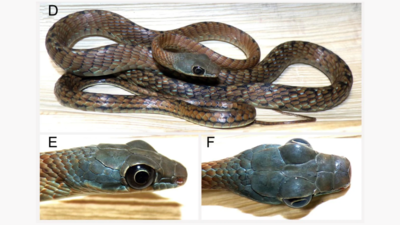
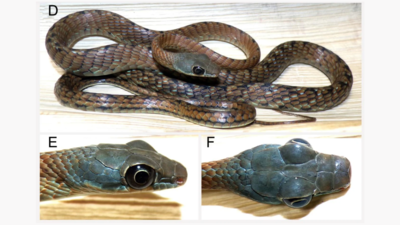
Scientists have formally identified a new species of tree snake from India’s Western Ghats, naming it Dendrelaphis beddomei, or Beddome’s bronzeback. The snake had previously been confused with the closely related large-eyed bronzeback, Dendrelaphis grandoculis. Researchers from India and Germany examined preserved specimens, historical records, live observations and photographs posted by citizen scientists to distinguish the two species. The new snake is mainly found at lower elevations on the windward slopes of the Western Ghats and has distinctive features including a red or pink tongue, white markings along its sides and, in some individuals, bold black blotches on its back.
Beddome’s bronzeback tree snake was hidden in plain sight among Western Ghats snakes
The researchers described Dendrelaphis beddomei as a new species in Taprobanica on 12 November 2026. The study was led by S.R. Ganesh, S.N. Poornaprajna, Ashok Kumar Mallik and Gernot Vogel. The team found that snakes previously identified as D. grandoculis actually represented two distinct forms. The new species was formally described using two roadkill specimens collected in January 2012 in Sullia, Karnataka, along with observations of live snakes and citizen-science photographs.
Beddome’s bronzeback vs large-eyed bronzeback: Red tongue and white side markings
Beddome’s bronzeback can be distinguished from the large-eyed bronzeback through several physical features. The new species has a red or pink tongue, while D. grandoculis has a black to greyish-black tongue. It also frequently has a white stripe or series of spots along its lower sides, a feature absent in the large-eyed bronzeback. Researchers found that Beddome’s bronzeback can also have bold black blotches on its back, a longer loreal scale and a smaller second postocular scale. Its subcaudal scale count can reach 168, compared with fewer than 133 in D. grandoculis.
The species lives mainly at lower elevations in the Western Ghats
The newly described snake is currently understood to be endemic to the Western Ghats south of the Goa Gap. Records place it from Vithura in the Agasthyamalai Hills northwards to Vibuthi Falls in Uttara Kannada, at elevations ranging from 44 to 1,038 metres. Researchers found that 60% of the recorded sightings were below 300 metres. The snake occurs in moist deciduous and semi-evergreen forests, as well as secondary and gallery forests, farmlands and plantations including rubber and areca nut estates.
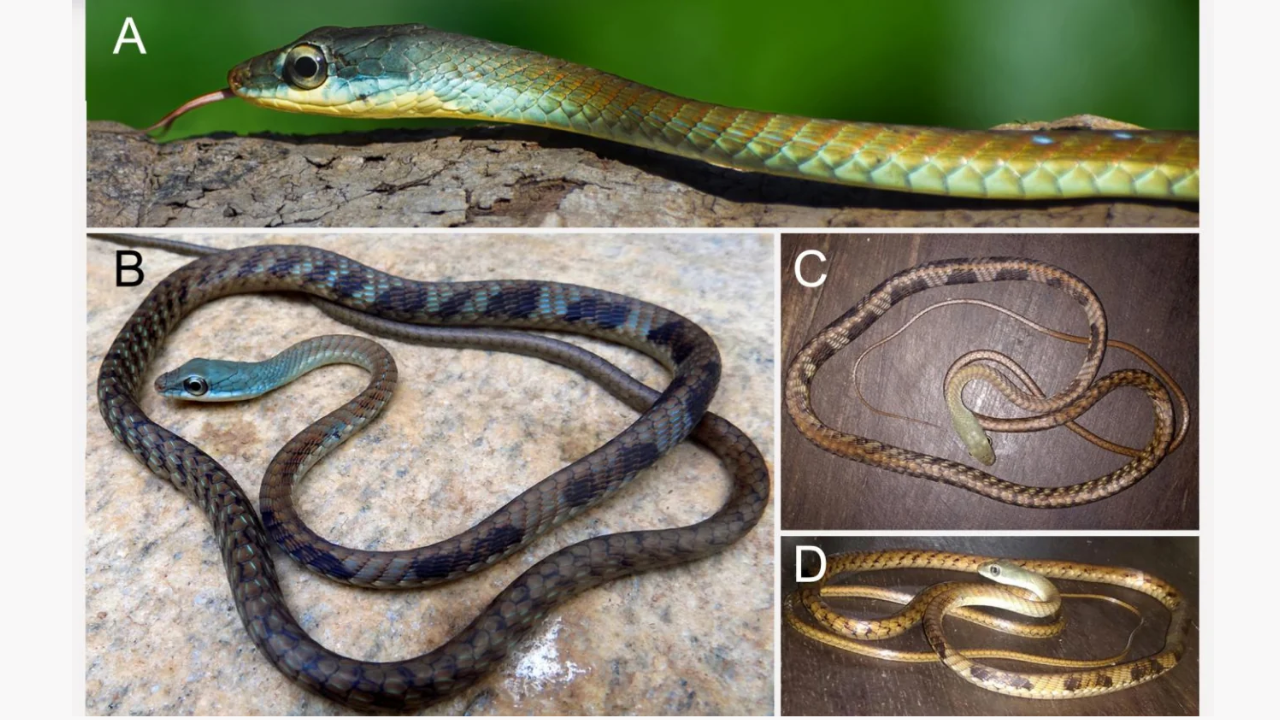
Dendrelaphis beddomei sp. nov., live adult individuals (not collected) from (A) Perdur; (B) Agumbe; Guddekeri, showing(C) dorsal and (D, E) dorsolateral views of the full body
Beddome’s bronzeback is an agile daytime snake that eats frogs
The species is arboreal, agile and active during the daytime, with observations showing it moving on vegetation. The researchers reported that it feeds on arboreal rhacophorid frogs and is oviparous. One gravid female killed by a vehicle in Agumbe was found carrying nine eggs in early March. Distribution modelling found the highest probability of occurrence around the Central Western Ghats between Puttur and Jog Falls, with suitable areas extending across the windward slopes between Wayanad and Uttara Kannada.
Road deaths threaten the newly described Beddome’s bronzeback
Road mortality emerged as a concern because both type specimens used to formally describe the species were killed on roads. The researchers said Beddome’s bronzeback appears to occur in several protected areas in Kerala and Karnataka and also survives in less-intensively managed plantations. Based on its distribution and known threats, they suggested that the species could qualify as Near Threatened under IUCN Red List criteria. This is a proposed assessment by the researchers, rather than a formal IUCN listing.
The snake was named after a 19th-century Western Ghats naturalist
The species name beddomei honours Colonel Richard Henry Beddome, who lived from 1830 to 1911 and made major contributions to biodiversity studies in the Western Ghats, particularly herpetology. The researchers noted that Beddome was the first Western explorer to visit the snake’s type locality at Sullia in 1870. They proposed “Beddome’s bronzeback” as the species’ common name. The study also highlights the value of citizen-science photographs in identifying poorly documented species and correcting long-standing taxonomic confusion.