
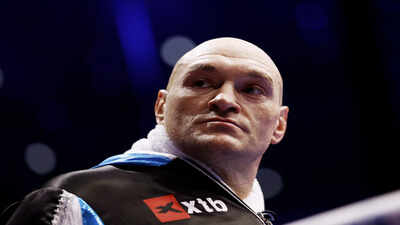
For Tyson Fury, the years following his 2015 victory over Wladimir Klitschko brought a collapse that few outside his inner circle fully understood. Behind the scenes, the heavyweight champion was battling severe mental health problems, hearing voices and becoming increasingly convinced that he and his family were in danger. Now, he has offered a deeply personal account of that period.
‘Words can’t explain the darkness I was in’
Fury, 38, says he was diagnosed with schizophrenia and bipolar disorder after being admitted to hospital in June 2016 with a suspected heart attack. Doctors concluded that he had suffered an anxiety attack, but the episode led him to seek psychiatric help in London.In a documentary about his life, which will be released on Netflix on November 27, Fury describes the severity of what he was experiencing.“Words can’t explain the darkness I was in,” he says.“It was like a living version of the pits of hell. I thought I would end up in a padded room with the door locked, and that scared me so much.“The anxiety was crippling me. I just could not overcome it and that’s when I went and saw the psychiatrist down in London. She asked me a gazillion questions, and I ticked all the boxes. Depression, anxiety, bipolar disorder.”Fury recalls hearing voices and believing that the radio was speaking directly to him. During his hospital admission, he begged his wife, Paris, to get him out because he believed the Illuminati wanted to kill him.Paris, 36, describes the moment she arrived at the hospital in the documentary. “I get there and Tyson looks at me, he’s got wires around him. He looks seriously frightened.”She recalls him telling her: “Get me out of here. The Illuminati, they’re all in on it. They can’t make me be quiet so they’re going to kill me.”Paris also told The Sun that she initially struggled to understand the diagnosis. “He’s a mild schizophrenic,” she says, before recalling her reaction when doctors explained the condition.“I thought ‘Don’t be silly, What’s she on about? Maniacs are schizophrenic.’”She added: “I asked ‘What’s bipolar?’ When someone explained it I thought, ‘Wow, that’s him to a tee’.”

Professional boxer Tyson Fury attends UFC Freedom 250 on the South Lawn of the White House, Sunday, June 14, 2026, in Washington. (AP Photo/Alex Brandon)
Fury says the problems had begun long before his hospital admission. “It wasn’t new. I got to 25, 26 and thought I’m just struggling now. I’ve always been struggling my whole life.”He also recalls experiencing anxiety as a child, even when there was no apparent reason to feel frightened. “I remember having a feeling of anxiety even though nothing bad was going to happen. I was five or six.”
Addiction, isolation and the Halloween turning point
The period after Fury defeated Klitschko was marked by a sharp decline in his personal life. He struggled with alcohol and cocaine addiction, gained considerable weight and found it increasingly difficult to manage his thoughts.“It got that bad I was hearing voices in my mind,” he says.“I wouldn’t be able to sit and have a conversation because I’d be hearing stuff in my mind.“I didn’t know where to turn and no-one knew what to do. I really needed help, or check into rehab or something.“I never got a break from it for years. I wanted to be what I thought was normal again.”Fury identifies a night out on Halloween in 2017 as the moment that forced him to confront how far his life had moved from the one he wanted. Wearing a glow-in-the-dark skeleton suit and full-face mask, he became embarrassed by his appearance and the state he had reached.“I went out and I was embarrassed by how I looked,” he says.“I was a fat mess and I had a glow-in-the-dark skeleton suit with full face mask on.“I looked around and could see all the young people and I thought, ‘I had the world in my hands and I threw it all away, and now I’m a fat mess addicted to alcohol’.”In another recollection from the documentary, Fury describes going upstairs, falling to his knees and asking God for help.“I went upstairs, I was down on my knees crying. I felt my chest wet with tears.“I prayed for God, ‘I can’t do this on my own anywhere. I need your help.’ And that was the comeback.”He returned to training and began rebuilding his life, with a greater focus on his family. The recovery eventually took him back to the top of heavyweight boxing, culminating in his victory over Deontay Wilder in 2020 and another world title.
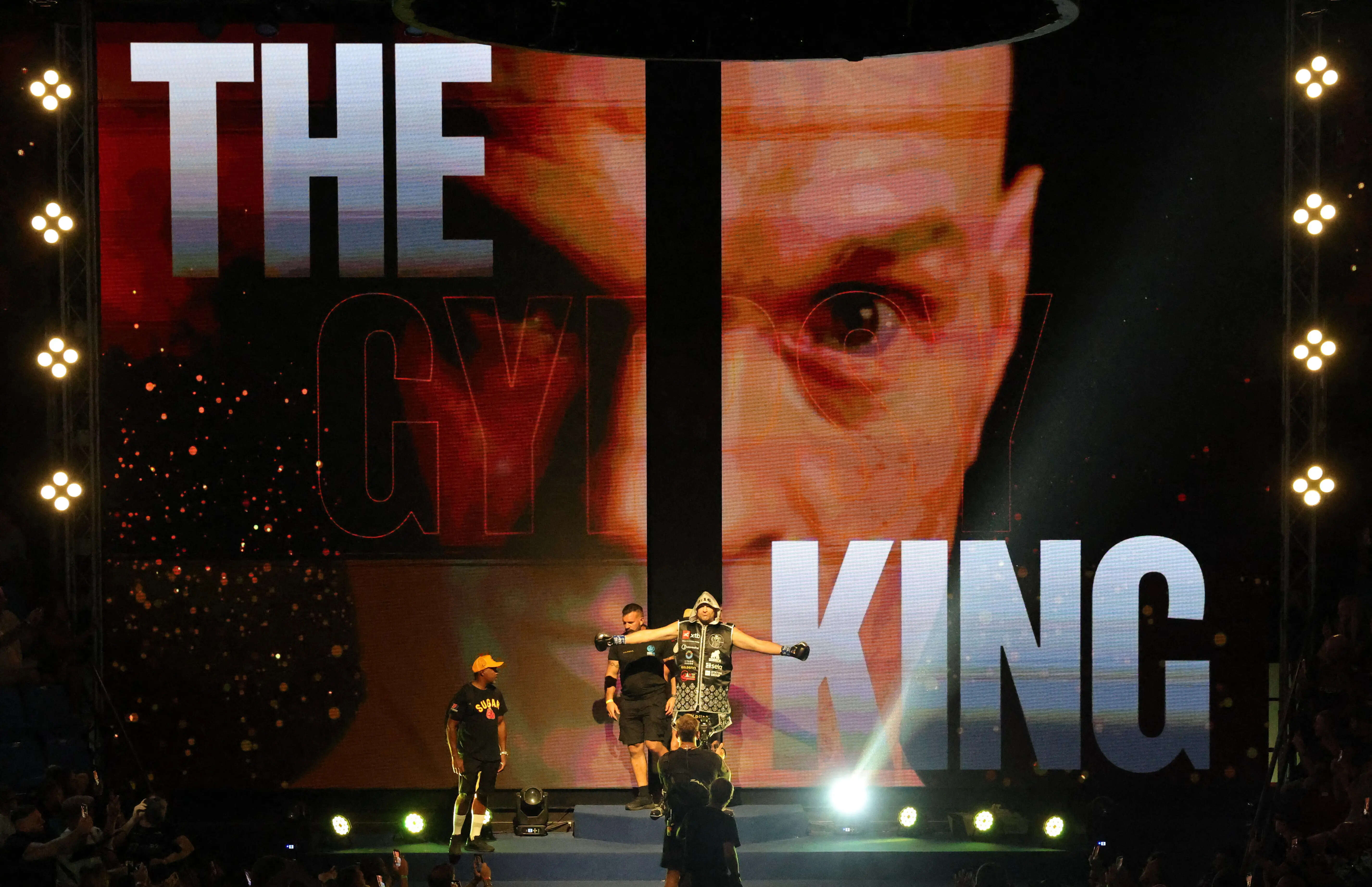
Boxing – Tyson Fury v Mariusz Wach – Max Muay Thai Stadium, Pattaya, Thailand – July 24, 2026 Tyson Fury during his ring walk before his fight against Mariusz Wach REUTERS/Athit Perawongmetha
Fury has also spoken publicly about the need to manage mental health rather than expect it to disappear. In a 2019 interview with The Telegraph, he compared the experience to the Eagles song Hotel California.“In that song there is a verse that says, ‘You can check out anytime you want, but you can never leave.’ And that’s mental health.“You can check out and try and get better, but the mistake you make is trying to leave. Because it won’t never let you leave. You must learn to maintain the disease of mental health.”“It’s a silent killer,” he added.
Fury prepares for Anthony Joshua showdown
Fury is now preparing for his long-awaited all-British heavyweight contest against Anthony Joshua, scheduled for December 11, 2026, at the Principality Stadium in Cardiff.The fight, described as a £200 million contest, is being billed as one of the biggest heavyweight match-ups of the generation. Fury called it the “biggest of our time and of our generation” during a press conference in London.The bout will be broadcast live on Netflix, which is also releasing the documentary Tyson Fury on November 27. Fury has said he now sees a psychiatrist every week as he continues to manage his mental health while preparing for the fight.The NHS describes schizophrenia as a form of psychosis, with symptoms that can include hallucinations, delusions and confused thoughts or speech. Bipolar disorder is characterised by extreme changes in mood. The two are distinct conditions, although Fury says he was diagnosed with both.