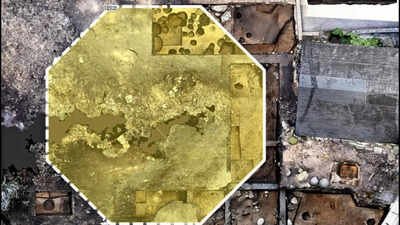
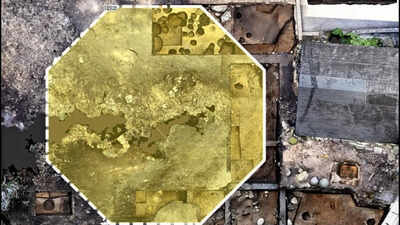
The abyss underwater is vast and mystical, it consists of creatures that stay unknown but glow the brightest, microorrganisms that sustain the ecosystem or metals and elements that are crucial for the world above. The world underwater is a mystery that keeps unfolding with constant efforts of the scientific community. Professor Satoshi Nakazono of Kagoshima International University has been trying to expose one such secret site on a Japanese Island since 2014. He has uncovered ceramics, roof tiles and other objects originating from China and different regions of Japan.There has been discovery of the foundations of an unusual octagonal structure which is suspected to be the remains of a Buddhist pagoda or religious building constructed around 900 years ago. The site is known as the Ōsato archaeological site located on Kuroshima, which is one of the islands of Mishima Village in Kagoshima Prefecture.Within an area of levelled ground which was previously recorded at the archeological site, a new octagonal arrangement has been identified. The absence of the upperstructure, however, has left the archeologists wondering the purpose of this unique building. The structure is approximately 8.9 metres between opposite corners of its upper section. While individual sides measure around 3.4 metres each. The structure also contains a lower section that is wider, measuring between 10 and 11 metres.
Connections to China
There have been previous discoveries of imported roof tiles from Ōsato, the recent findings can help in explaining the questions behind them. While the tiles are characteristic of China’s Southern Song period, Kuroshima is the southernmost known location in Japan where this kind of tiles have been found. Other regions which were closely associated with medieval maritime trade between Japan and China, like Hakata and Kyushu have revealed similar tiles.Earlier research, in 2015, made the discovery of tiles made from the same moulds at Ningbo in China. After further research involving chemical analysis of the samples from the two sites, it was revealed that the examples discovered in Japan had also been produced there. This is especially insightful as it implies that the building materials travelled approximately 1,000 kilometres by sea before reaching Japan.The latest research has raised the possibility that these imported tiles might have been used to roof an octagonal religious structure at Ōsato. Further research, if it confirms the usage, will point to not just transport of construction material but the propagation of architectural styles between the two countries.
Could the structure be religious in origin?
There have been estimations of the structure being religious, specifically of Buddhist origin. This is because octagonal architecture has associations with Buddhist religious buildings in Japan and China, like pagodas and religious halls. After studying the plan and archeological context, Nakazono and his team have made inferences that suggest Ōsato structure may have housed a pagoda or another sacred building. The structure is also placed within an area believed to have held religious significance and the discovery of Chinese-style roof tiles.The structure revealed has been compared with other similar octagonal religious architecture elsewhere in East Asia. Two of them are present in Japan itself- the nine-storey pagoda formerly standing at Hōshō-ji Temple in Kyoto and the three-storey pagoda at Anraku-ji Temple in Nagano. While the comparisons help in finding the origins of the discovery, the true nature remains uncertain.
Beyond religion, trade routes revealed
Kuroshima’s location along the maritime routes of southwestern Japan may explain how imported goods found their way to these otherwise small and remote islands of Japan. The ceramics unearthed at Ōsato suggest that its residents were connected to wider trading networks, rather than being isolated from the outside world. Nearby Iōjima also played a role in regional commerce during the medieval period, when it was known for its sulphur trade, an important commodity exported to China.