Summer drought had left parts of California’s Scott River watershed struggling to sustain the streams that young coho salmon depend on. In some stretches, water levels fell so low that creeks could no longer provide reliable habitat through the warmer months. A restoration project launched took an unusual approach to the problem. Instead of rebuilding the waterways with expensive engineering work, conservation teams placed wooden posts and willow branches across selected streams, creating structures that mimicked natural beaver dams. The results became apparent over the following years, with more young salmon surviving, vegetation spreading along the banks and adult fish returning in far greater numbers.
How artificial beaver dams changed the streams
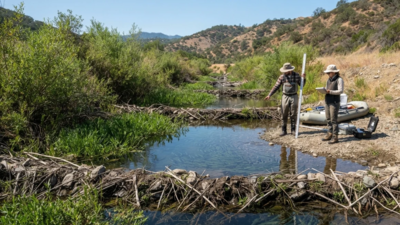
The work began in Sugar Creek, a tributary of the Scott River in Northern California’s Klamath Basin. Its condition reflected decades of changes to the surrounding landscape. Early gold mining, logging and water diversions had altered the creek, leaving parts of it prone to drying out during summer. Coho salmon had historically used the waterway, but the deteriorating conditions made it increasingly difficult for the fish to survive.When NOAA Fisheries scientists joined the Scott River Watershed Council to test a relatively inexpensive restoration method. They installed structures known as beaver dam analogues, or BDAs, using wooden posts and interwoven willow branches. Positioned across the creek, these barriers slowed the movement of water and encouraged it to spread into surrounding areas rather than quickly flowing downstream.The approach was based on the way natural beaver dams influence streams. By holding back water, the structures can create deeper pools, improve water retention and help restore the conditions required by aquatic wildlife.Sugar Creek was not the only waterway involved. Similar installations were carried out in French Creek, another tributary in the watershed. The two locations subsequently became important sites for monitoring how the restoration work affected coho salmon populations.
How beaver dam-like structures transformed California streams into better salmon habitats
The changes were not limited to water levels. As the streams retained more water, their surrounding vegetation began to recover, creating a different environment along the banks. Pools and slower-moving sections provided additional places for juvenile salmon to shelter and grow.The research estimated that the improved habitat could support more than 7,000 additional juvenile coho salmon. Cooler water temperatures also helped create conditions in which young fish had a better chance of surviving. This was particularly important during summer, when streams in drought-affected parts of California can become too warm or lose much of their flow.There were concerns before the project began that slowing the water might have unintended consequences. Warmer pools, for example, could potentially become unsuitable for salmon or encourage invasive species.The observations from Sugar and French creeks, however, showed a different pattern. Fish populations increased as the stream environments recovered.Charrna Gilmore, executive director of the Scott River Watershed Council, said photographs taken from fixed monitoring points captured how vegetation spread through areas that had previously looked very different. The extent of the growth was not something the team had anticipated when the structures were first installed.
How stream restoration helped increase adult coho salmon returns in California
The longer-term figures provided another indication of how the restoration work had affected the watershed. Before the project, salmon populations across the surrounding rivers were facing difficult conditions, particularly during drought years.In 2015, the year after the first artificial dams were installed, the Scott River accounted for roughly 25% of the adult coho salmon returning across four monitored rivers. These included the Scott, Bogus Creek, Trinity and Shasta rivers.By 2020, the Scott River’s share had risen to more than 75%. The increase suggested that adult salmon were increasingly returning to a waterway where the restored habitat offered better conditions for survival and reproduction.NOAA Fisheries research scientist Michael Pollock, who led the study, said the response challenged doubts about whether the relatively simple structures would make a meaningful difference. The return of adult fish provided evidence that improvements to juvenile habitat were translating into changes further along the salmon life cycle.The researchers also cautioned that the success of juvenile salmon depended on conditions beyond the artificial dams. Snowpack during the preceding winter remained important because it helped determine how much water would be available to sustain the streams during warmer months.
Why restoring beaver-like conditions matters
Beavers once played a much larger role in shaping waterways across the Scott River watershed. Historical accounts from the 1800s described an extensive network of streams and wetlands in the region. The landscape was so closely associated with the animals that trappers referred to the area as Beaver Valley.Records indicate that around 1,800 beavers were trapped there in 1850 alone. Their removal, alongside other changes to the landscape, contributed to the disappearance of many of the natural structures and wetlands that had once helped retain water.The artificial dams are intended to recreate some of those lost conditions. Branches and woody material slow water movement, allowing more of it to seep into the ground. This can raise groundwater levels and help maintain stream flows during periods when surface water would otherwise become scarce.Water stored underground can also emerge gradually, helping keep creeks cooler during the summer. For salmon, which are sensitive to changes in water temperature and flow, these conditions can make a substantial difference to the availability of suitable habitat.The process also allows vegetation along the waterways to recover. As plants become established, their roots help stabilise stream banks and contribute to the development of healthier riparian areas.
Natural beavers begin taking over some dams
An unexpected development followed the restoration work at certain locations. Wild beavers began using and reinforcing structures in parts of the watershed, suggesting that the artificial installations could eventually create conditions in which the animals might return to their former role.A trail camera recorded a beaver working on a dam while coho salmon swam through the nearby water. The footage offered a glimpse of how the restoration structures and natural beaver activity could work together.Gilmore said the long-term intention had been to allow beavers to take over the work, given their ability to build and maintain dams. The animals’ return could help sustain the restored habitat without requiring people to continually construct new structures.The watershed council has since expanded its restoration efforts, installing more BDAs and carrying out other projects within streams. One additional installation upstream of the original Sugar Creek structures was associated with the highest density of spawning coho salmon recorded anywhere in the watershed in 2024.
A lower-cost approach to salmon recovery
The findings, published in the journal Frontiers in Ecology and Evolution in July 2026, titled, ‘Riparian wetland creation using beaver dam analogues improves threatened salmon populations amidst severe drought’ add to research examining how beaver-like structures can improve conditions for salmon and other fish. Earlier projects in the Pacific Northwest had reported benefits for salmon and steelhead, but the approach had received less attention in drought-prone parts of California’s Klamath Basin.The method could also offer an alternative to more expensive restoration projects involving the reconstruction of river channels. Artificial beaver dams use relatively simple materials and can be installed without the scale of engineering work associated with major stream reconstruction.For conservation groups working with limited funding, the potential to improve habitat across several waterways at comparatively low cost is an important consideration. The Scott River Watershed Council has also worked with state wildlife officials to simplify the permitting process, which could make similar projects easier to carry out elsewhere.