
Diwali is more than a festival of lights. For generations, it has also been an occasion for Indian businesses, traders and households to review their finances, begin new accounts, buy gold and make investments.While these customs have retained their significance, the way people observe them has evolved. Physical account books have given way to digital ledgers, gold purchases now include investment-oriented products, and younger investors are exploring financial markets.Here is how five Diwali traditions connect culture, commerce and India’s economy.
An occasion for wealth creation
Diwali has traditionally been associated with prosperity and the worship of Goddess Lakshmi, the deity of wealth. For households, it is an occasion to buy valuables, purchase gold, set aside savings and plan finances for the year ahead.Wealth creation is no longer limited to physical assets. Alongside gold and traditional savings instruments, households are exploring mutual funds, shares and other financial products. Diwali or Dhanteras can also serve as a starting point for investing.Dr Shunil Tripathi, an NCFE trainer empanelled with the RBI, SEBI, IRDAI and PFRDA, said festivals can provide a cultural and emotional motivation to move from saving to investing. The challenge is to turn an occasional decision into a regular habit through financial awareness and long-term planning.“The basic philosophy, however, remains similar: save today to secure tomorrow,” he said.

Inculcating regular investment habits
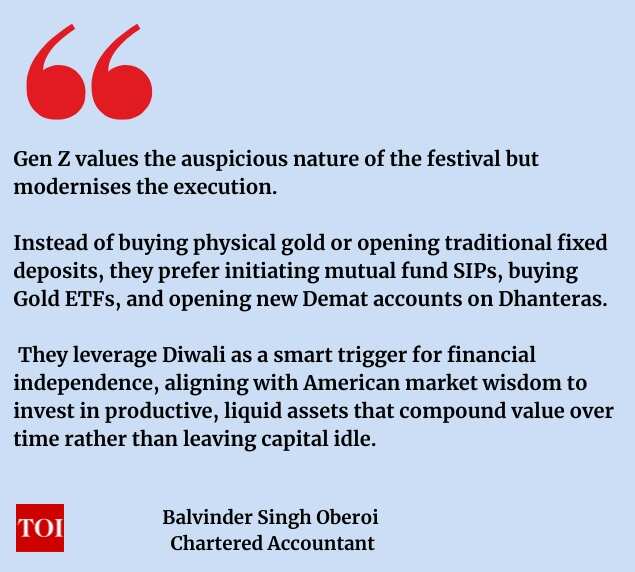
Younger investors may mark the occasion by starting a mutual fund systematic investment plan (SIP), buying Gold ETFs or opening a Demat account. These serve different purposes: a SIP enables regular investment, while a Demat account holds securities. The larger shift is towards using the festival to think about long-term financial goals.
GenZ’s new traditions
Red account books to digital ledgers
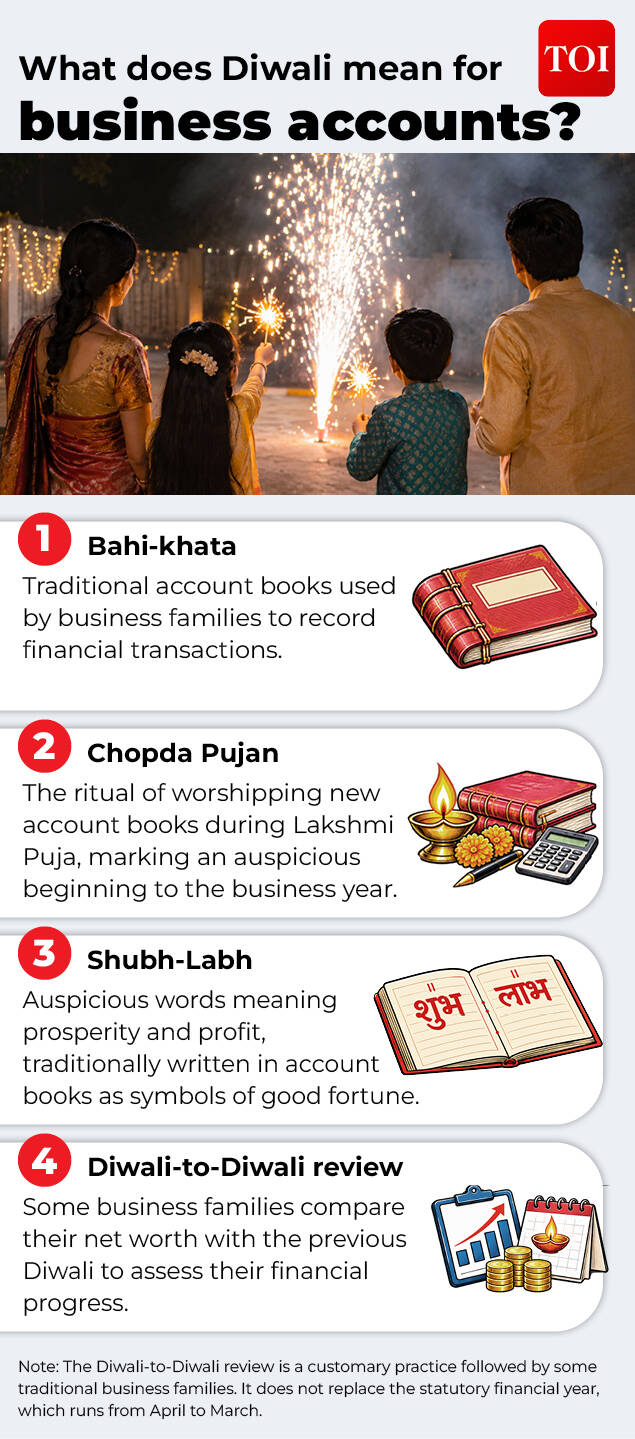
For many Indian trading communities, particularly in Gujarat, Diwali marks the beginning of a new business year. One prominent tradition is Chopda Pujan, the ritual of worshipping account books before beginning a fresh set of financial records.Traditionally, business families closed old accounts and worshipped new bahi-khatas during Lakshmi Puja. The books were marked with auspicious words such as Shubh and Labh, symbolising prosperity and a fresh beginning.
Diwali traditions linked to finances
The practice continues in some families, even as formal accounting has shifted to digital systems. GST has added to businesses’ formal record-keeping and compliance obligations, including maintaining transaction records, issuing tax invoices and filing periodic returns. Accounting software and digital ledgers are now part of routine operations.There is also an important distinction between customary Diwali-to-Diwali reviews and statutory accounting. Financial reporting, income-tax filings and GST compliance follow the April-to-March financial year. Some traditional businesses nevertheless maintain bahi-khatas alongside formal records and compare their net worth from one Diwali to the next. Net worth is calculated by subtracting liabilities from assets.Chartered accountant Balvinder Singh Oberoi said festive-period sales were another important measure. “One financial metric they do track religiously is festive period sales,” he said, referring to businesses comparing sales during the Diwali period with the corresponding period a year earlier.
Dhanteras and the gold rush: Buying precious metals
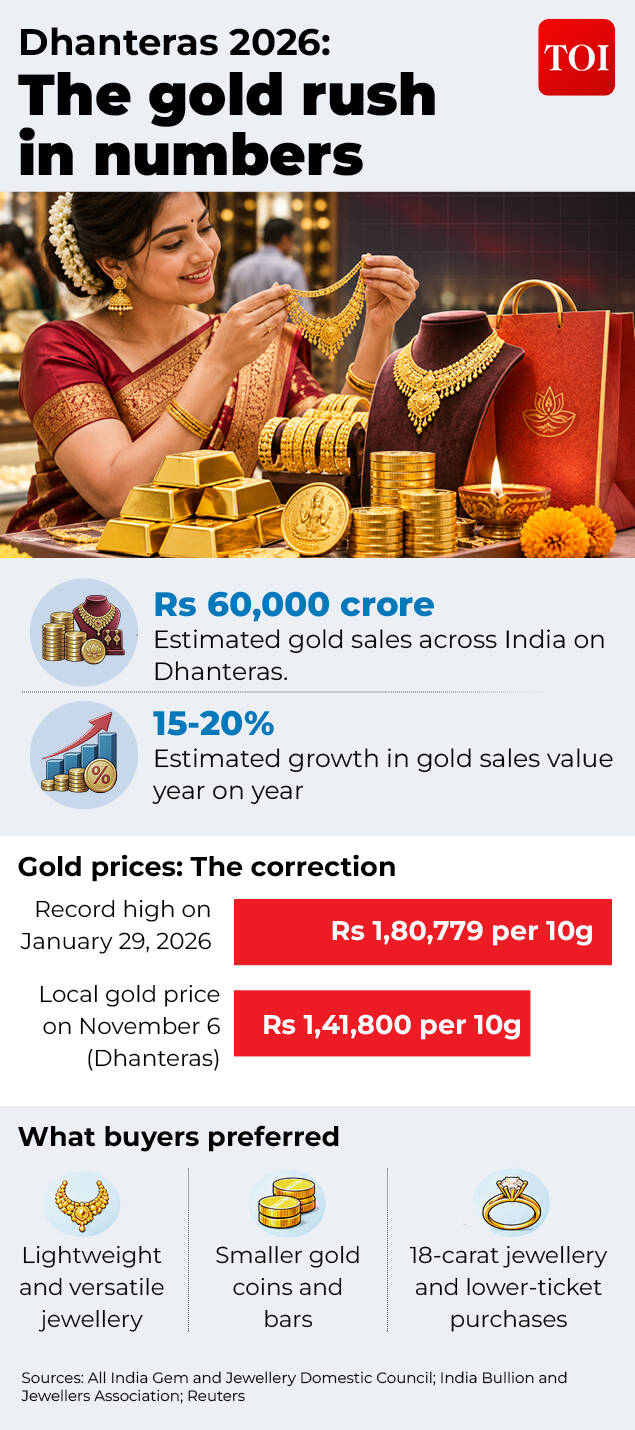
Buying gold on Dhanteras is among India’s most enduring festive traditions. Associated with prosperity, security and wealth preservation, the occasion is particularly important for jewellery retailers, bullion dealers and precious-metal businesses.Buying patterns are evolving. Consumers are showing interest in lightweight designs, smaller denominations of gold coins and bars, and exchanges of old gold for new jewellery. High prices have encouraged some buyers to adapt the size and design of their purchases rather than abandon the tradition.This year’s Dhanteras, observed on November 6, brought fresh momentum for jewellers as gold prices eased from record levels. Reuters reported local gold prices at around Rs 1,41,800 per 10 grams on Friday, after falling to Rs 1,37,863 earlier in the week, their lowest level since March 24. The correction brought some buyers who had been waiting for more favourable rates back to jewellery stores ina addition to those who waited for the cultural significance.
The gold rush in festive season
The All India Gem & Jewellery Domestic Council (GJC), in a preliminary assessment after Dhanteras, estimated gold sales at around Rs 60,000 crore, up 15-20% in value terms from the previous year. Volumes were expected to remain broadly unchanged, suggesting that higher prices accounted for much of the increase in sales value.Demand also extended to diamond jewellery, with wedding shoppers and families contributing to purchases.Demand for diamond jewellery also reportedly grew 25-30% during the festive period.
The Diwali economy: Where does India’s festive money go?
The festive season is a crucial consumption period for several industries. Alongside FMCG, automobiles, consumer durables, jewellery and apparel, spending also benefits travel, hospitality and premium gifting. Ecommerce has also been a key contributor in this aspect, allowing quick deliveries, festival sales and wide variety.Ravi Kapoor, partner and leader for the retail and consumer sector at PwC India, included travel and premium gifting among the categories that gain from festive demand. He pointed to the long holiday period as a reason more families are open to travelling. “A lot of families actually now are quite open for travel,” he said.Kapoor estimated that “in automobiles roughly a quarter to 30% of volumes happen in this period”. He added: “Same is the number for durables. 30 to 40% durables get sold right.”The demand story is also spreading beyond metropolitan households. Kapoor said e-commerce, digital payments and better physical infrastructure had widened access to consumers in smaller cities and towns. “The access has become much, much better, much easier,” he said, pointing to the growing contribution of Tier-II and Tier-III markets to new online customers.However, higher festive sales do not automatically mean that households have become more financially comfortable. The source of the spending matters: purchases supported by improved incomes and savings may point to stronger consumption, while those financed by stretching household budgets may be harder to sustain.Economist Dr Rohit Kumar Singh said this distinction was central to assessing demand. “Are households spending more because their incomes and savings have improved, or are they stretching their budgets to make room for festive purchases?” he asked.Anand Ramanathan, partner and consumer industry leader at Deloitte South Asia, also highlighted the gap between financial confidence and spending capacity. Deloitte’s March 2026 ConsumerSignals survey found that 79% of Indian consumers were confident about meeting upcoming payments and 60% were comfortable with their savings. However, only 65% were willing to make large purchases, down five percentage points from the previous month. Just 43% said they could afford to spend on things that brought them joy.
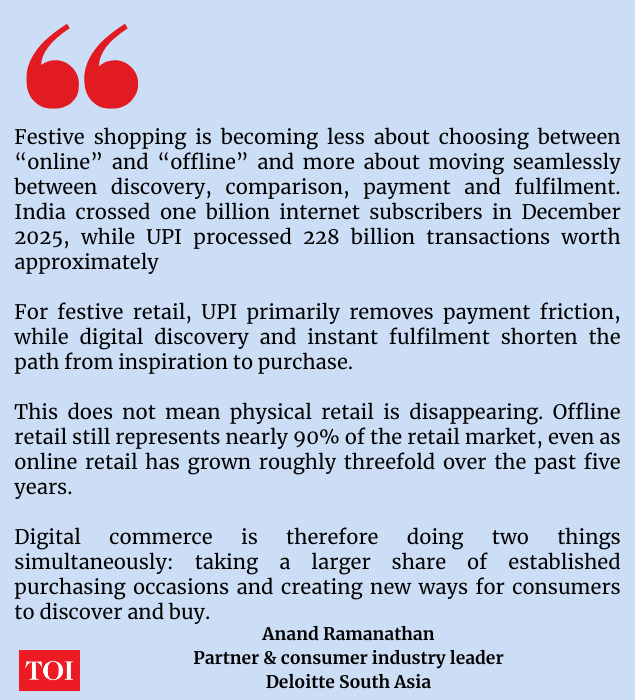
Festive shopping: Online vs offline
The findings suggest that financial confidence does not always translate into a willingness to make discretionary purchases. Whether consumers continue spending after the festive season will be a better test of how durable the demand is.
Muhurat trading : When Diwali meets the stock market
Diwali’s association with wealth and prosperity also extends to India’s stock markets. Every year, the BSE and NSE hold a special trading session on Diwali, known as Muhurat trading, marking the beginning of the new Samvat year.Many investors consider the session auspicious and use it to make a symbolic investment or begin a longer-term investment plan. The tradition dates back to the BSE’s introduction of the session in 1957; the NSE began holding it in 1992.How have markets performed?Both the Sensex and Nifty closed higher in eight of the last 10 Muhurat trading sessions from 2016 to 2025. The two exceptions were 2016 and 2017. The indices then recorded eight consecutive positive sessions from 2018 through 2025. In the 2025 session, the Sensex gained 63 points, while the Nifty rose 25 points.These gains, however, reflect movement during a single special session, not returns over the full Samvat year. An auspicious start does not guarantee market gains. Investors still need to assess companies, understand their risk appetite and maintain a diversified portfolio.Muhurat trading brings together faith and finance, giving the stock market a cultural connection beyond its regular trading calendar. The more meaningful step is to carry the discipline of that beginning into the rest of the year.
Experts decode: What the festive season tells us about India’s economy
Diwali sales offer a snapshot of India’s consumption economy, but the festive rush also raises larger questions. Is spending broad-based or concentrated among affluent households? Are consumers buying more, or simply paying higher prices? And does the demand generated during the festive season translate into sustained growth for businesses?A more selective household walletAnand Ramanathan, partner and consumer industry leader at Deloitte South Asia, said India’s festive consumption story reflected a larger market but more selective spending. Consumers are reallocating budgets towards purchases they consider worthwhile.“The story is increasingly one of a larger consumption economy combined with a more selective household wallet,” he said.Smaller discretionary purchases are increasingly spread throughout the year, while big-ticket items such as appliances and electronics remain linked to festive discounts and financing. Food, sweets and entertaining, meanwhile, generate occasion-led demand. Ramanathan described Diwali as “a blend of accelerated demand and occasion-created consumption”.The wider economic impactEconomist Dr Rohit Kumar Singh said festive demand supports more than retailers. Manufacturers, transporters, warehouses, packaging companies and MSMEs also benefit, while seasonal hiring creates temporary employment. “The festive season also supports a much wider network of businesses. Manufacturers, transporters, warehouses, packaging companies and MSMEs all benefit from the increase in activity,” he said. However, smaller businesses can face unsold inventory, delayed payments and working-capital pressure. Higher input costs, including crude oil, can further squeeze margins.
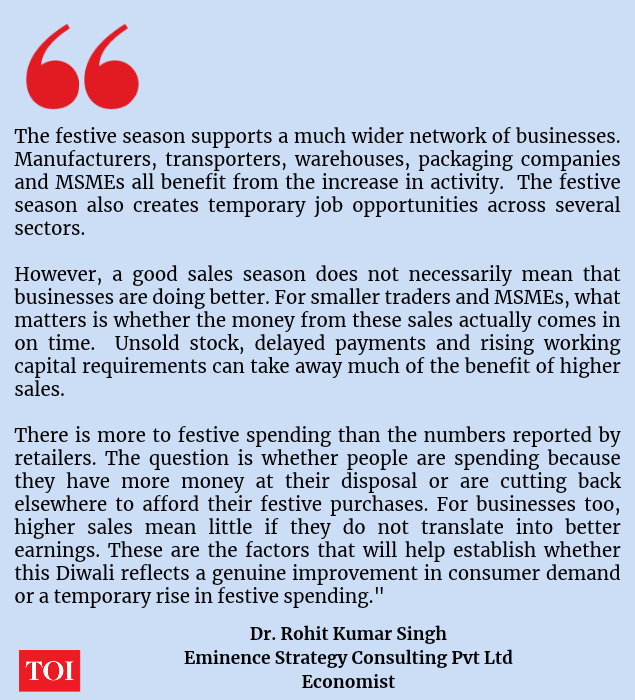
How festive season supports businesses
Financial disciplineDr Shunil Tripathi, the NCFE trainer empanelled with RBI, SEBI, IRDAI and PFRDA, said Diwali could be an opportunity to review income, expenditure, savings, investments and financial goals. Traditional practices of setting aside money, grains or gold reflected the idea of preparing for the future. “The basic philosophy, however, remains similar: save today to secure tomorrow,” he said. But social pressure and the desire to keep up with others can also lead to unnecessary purchases and borrowing.From auspicious trades to long-term investingChartered accountant Balvinder Singh Oberoi said the symbolic investment made during Muhurat trading could be a starting point for greater financial awareness. “Muhurat trading provides that crucial first step to getting started,” he said. The real value lies in using the occasion to understand markets and build a consistent, long-term investment habit rather than treating a token purchase as wealth creation.Festive trends versus lasting shiftsRavi Kapoor, partner and leader for the retail and consumer sector at PwC India, cautioned against treating every festive-season trend as a permanent change in consumption. One structural shift, he said, was the movement from unbranded to branded products, including in categories such as sarees, jewellery and food.“The long term consumption story is very clearly the growth of formal consumption, the growth of formal economy in the country,” he said.Kapoor also described India as an “E-shaped economy”, with affluent households relatively insulated from economic changes, middle-income consumers spending cautiously and lower-income groups facing tighter constraints. Whether festive demand continues after Diwali, and whether the shift towards organised brands persists, will offer a better indication of the economy’s underlying consumption trends.
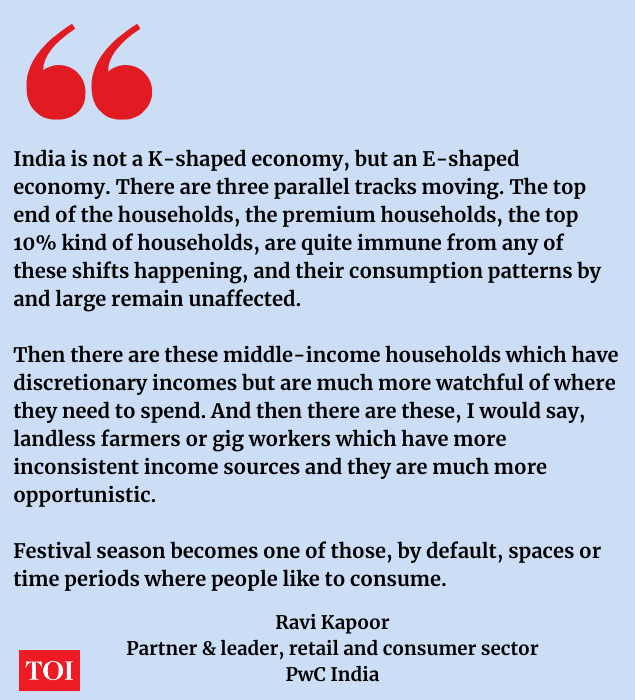
K-shaped economy
TakeawayUltimately, Diwali’s economic significance goes beyond a surge in shopping or a promising start to the business year. It brings together consumption, investment and traditional practices, while offering a window into changing household priorities. Whether this festive momentum translates into sustained demand and long-term financial discipline will become clearer in the months ahead.