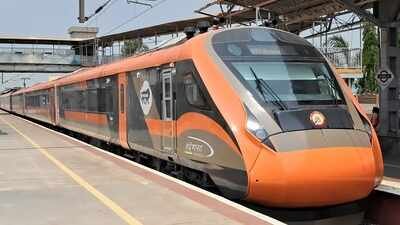
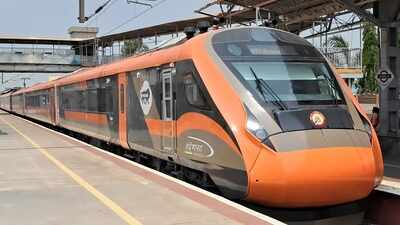
Vande Bharat Express trains had till the start of this year been manufactured only at the Integral Coach Factory (ICF) in Chennai. However, in 2026 the other two Indian Railways’ coach factories – Rail Coach factory (RCF) Kapurthala and Modern Coach Factory rolled out their first Vande Bharat Express trains.And now the 16-coach Vande Bharat Chair Car train set which has been manufactured at RCF Kapurthala has successfully been tested at speeds of 180 kilometres per hour.The train set successfully underwent a high-speed trial at 180 kmph on the Mathura–Nagda section on 8 October 2026, under the supervision of the Chief Commissioner of Railway Safety (CCRS).
180 kmph speed test for RCF’s Vande Bharat
The CCRS inspection assessed the trainset’s performance at high speeds, operational efficiency and compliance with safety parameters.Successfully completing the inspection is an important step in the development of advanced Vande Bharat trainsets.Also Read | After launching Vande Bharat sleeper train with 16 coaches, Indian Railways now bets on 24-coach variant of new train with pantry car and features better than Rajdhani ExpressRCF Kapurthala’s production includes coaches for advanced train sets such as Vande Bharat and Amrit Bharat.The factory’s capabilities have also received international recognition, with its railway coaches being exported to several countries in Asia and Africa. These exports have helped expand India’s footprint in the global railway market.RCF Kapurthala recorded its highest-ever annual output in FY 2025–26, manufacturing 2,383 coaches during the year.
Vande Bharat Express
Vande Bharat Express, called Train 18 after the year it was manufactured in, was first rolled out in a record time of 18 months. The first Vande Bharat Express was launched in 2019 between Delhi and Varanasi.The fully air-conditioned train set has brought several technological advances to passenger services, opening a new chapter in the country’s railway travel experience.Unlike conventional trains that depend on a separate locomotive for traction, the train set can reach speeds of 180 kmph without requiring an engine to pull it.Also Read | Indian Railways exports first 18-coach LHB train for Bangladesh as part of 200 coach order; specially designed coaches feature CCTVs, baby care and prayer rooms, and other passenger-friendly amenitiesOne of the key improvements is its capacity to accelerate and decelerate more rapidly than conventional trains. This capability can reduce journey times by up to 20% across several routes.The train also brings together a range of passenger conveniences and digital features. These include European-style seats, automatic doors, GPS-enabled passenger information systems and onboard infotainment. Its regenerative braking technology helps improve energy efficiency during operation.Semi-permanent couplers are designed to minimise jerks, along with improved suspension systems, help deliver a smoother ride. Regenerative braking also supports more efficient operations by recovering energy as the train slows down.Automatic plug doors and wider, fully sealed gangways allow passengers to move between coaches while creating a more unified structure, instead of treating each coach as an independent unit.Vande Bharat includes provision for KAVACH, India’s indigenously developed Automatic Train Protection system, which is certified to Safety Integrity Level-4.The trainset has continued to evolve through successive upgrades. The Vande Bharat 3.0 version can go from 0 to 100 kmph in around 52 seconds. It also offers lower levels of noise and vibration, adding to the improvements in its performance and passenger experience.