Astronomers using the European Southern Observatory’s Very Large Telescope (VLT) have imaged a shock wave around a white dwarf, the leftover core of a dying low-mass star, that known mechanisms cannot explain. According to the European Southern Observatory press release of 12 January 2026, the star, RXJ0528+2838, lies 730 light-years away and has been expelling a powerful outflow for at least 1000 years. The study, co-led by Krystian Iłkiewicz and Simone Scaringi, is published in Nature Astronomy. According to the paper, the energy needed to sustain the structure exceeds what the system’s accretion can supply. This article sets out what was observed, which explanations were ruled out and what remains unexplained.
What makes the white dwarf RXJ0528+2838 unusual
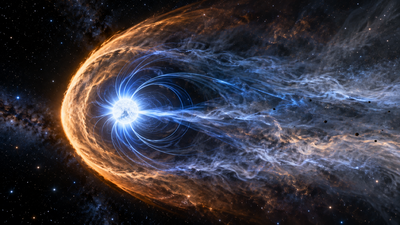
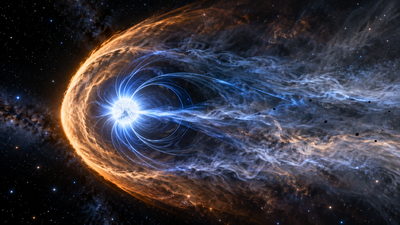
Gas and dust flowing from stars can clash with a star’s surroundings under the right conditions and create a shock wave. RXJ0528+2838 is a white dwarf with a Sun-like companion orbiting it. ESO states that in such binary systems, material from the companion is transferred to the white dwarf, often forming a disc around it, and that some of this material is ejected into space as powerful outflows. However, ESO reports that RXJ0528+2838 shows no signs of a disc, which makes the origin of the outflow and the nebula around the star a mystery.According to the study published in Nature Astronomy titled ‘A persistent bow shock in a diskless magnetised accreting white dwarf’, RXJ0528+2838 is a short-period polar-type cataclysmic variable with an orbital period of 80 minutes. The authors report a magnetic field strength of about 42 to 45 MG, derived from cyclotron harmonic structures in the Multi Unit Spectroscopic Explorer (MUSE) spectrum. Noel Castro Segura of the University of Warwick, quoted by ESO, describes the bow shock as “similar to the wave that builds up in front of a ship”. The paper adds that approximately 36% of accreting white dwarfs host strongly magnetised white dwarfs, yet extended nebular structures around polars are virtually non-existent, apart from a nova shell around V1500 Cyg.
How did astronomers discover the bow shock around a white dwarf
The team first noticed a strange nebulosity around the star in images from the Isaac Newton Telescope in Spain. The paper states that the structure was identified in Hα imaging from the INT Galactic Plane Survey (IGAPS). Noticing its unusual shape, the team observed it in more detail with the MUSE instrument on the VLT. The paper reports a total observing time of 35,850 seconds spread over 33 frames. According to Iłkiewicz, as quoted by ESO, the MUSE observations allowed the team to map the bow shock and analyse its composition, which was crucial to confirm that the structure originates from the binary system and not from an unrelated nebula or interstellar cloud.The paper reports that the size of the bow shock differs depending on the emission line observed. The apex lies about 16.7 arcsec from the star in the hydrogen Balmer lines (3800 AU, projected), 10.5 arcsec in [N II] (2400 AU, projected) and 6.25 arcsec in [O III] (1400 AU, projected). According to the paper, [S II] emission lacks a clear bow shock geometry. The authors also report a trailing [N II] tail with a projected length of at least 57 arcsec, which they say implies an outflow over the past 1000 years or more. ESO gives the same minimum duration of at least 1000 years.
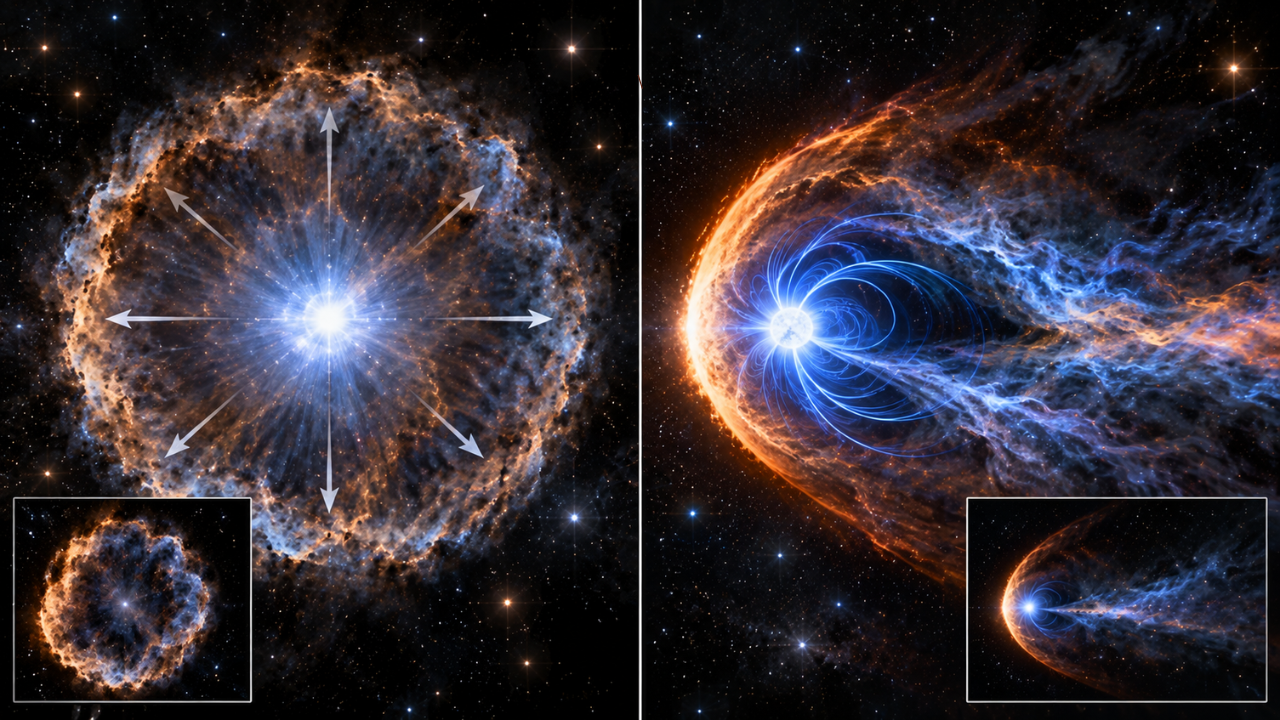
Image AI generated
Why is the nebula around RXJ0528+2838 not a classical nova remnant
The nebula does not match a classical nova remnant. The authors state that nova shells generally keep a spherical or elliptical symmetry, whereas the nebula around RXJ0528+2838 is sharply asymmetric and aligned with the star’s proper motion. They also report that the radial velocities of the [N II], [O III] and [S II] lines remain uniform across the bow shock, while nova shells are known to show a radial velocity structure indicating quasi-spherical expansion. According to the paper, the trailing tail implies a continuous or quasi-continuous outflow, which is inconsistent with the episodic ejection expected from nova eruptions.The paper states that bow shocks unrelated to nova outbursts have been identified in only six cataclysmic variables, and that these are generally attributed to accretion disc winds or enhanced winds from the donor star. According to the authors, the lack of an accretion disc in a polar rules out disc winds. For a typical red-dwarf wind mass-loss rate of about 10⁻¹⁴ solar masses per year, the paper states that the required wind velocity would be of the order of 10⁵ km/s, which also excludes a donor-star wind. The authors add that a pulsar wind is ruled out by the white dwarf’s nature and magnetic field, and that MeerKAT radio observations detected no emission at the star’s catalogued position.
How much energy does the bow shock around RXJ0528+2838 need
The power needed to sustain the bow shock is about 8.2 × 10³² erg/s. The authors report that a cataclysmic variable with a similar orbital period is expected to have an accretion luminosity of 2.4 × 10³² erg/s, so the energy required exceeds the system’s accretion luminosity by a factor of about 3. The paper also gives an upper limit of 2 × 10³² erg/s for the white dwarf’s spin-down luminosity, which it describes as at least a factor of 4 below the energy needed. According to the authors, the white dwarf’s magnetic energy of about 1.6 × 10⁴¹ erg would be depleted within about 600 years at that power, which is in tension with the tail’s age of at least 1000 years.The data show the current magnetic field is strong enough to power a bow shock lasting only a few hundred years, so it only partly explains the observations. Scaringi calls the unknown power source a “mystery engine”, according to ESO. The paper concludes that the system requires a “previously unrecognised energy loss mechanism”, potentially tied to magnetic activity, which may operate over timescales long enough to influence binary evolution. According to ESO, many more binary systems need to be studied, and its upcoming Extremely Large Telescope will help astronomers map more of these systems, including fainter ones.