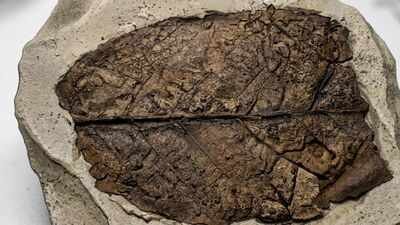
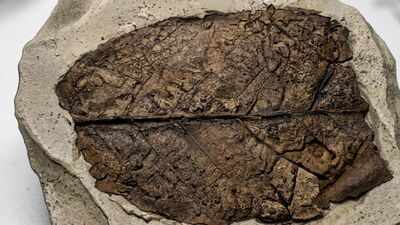
A fossilised leaf from the western Himalaya has preserved a previously unknown fungal species that lived around 12 to 8 million years ago. The fungus, Vizellopsidites miocenicus, was found on a fossilised dicot leaf recovered from the middle Siwalik sediments of Himachal Pradesh.Researchers Sampa Kundu and Mahasin Ali Khan described the species in a study published in the New Zealand Journal of Botany titled ‘A New Epifoliar Fossil Fungal Species, Vizellopsidites miocenicus, From India’. The fungus covered the upper surface of the leaf cuticle with a distinctive network of dark brown structures. Its position on the leaf also preserved evidence of an ectoparasite relationship between the fungus and its host plant in the warm, humid tropical Siwalik forest of the Himachal Himalaya.
A new fossil fungus was found on a Miocene leaf
The newly described species is Vizellopsidites miocenicus sp. nov., an epifoliar ascomycotal fossil fungal species. It was recovered from the middle Siwalik sediments of Himachal Pradesh in the western Himalaya. The sediments date to the Late Miocene, around 12 to 8 million years ago. The fossil fungus was preserved on the adaxial surfaces of cuticular fragments from a fossilised dicot leaf. Researchers identified features that distinguish the fossil while also noting similarities with modern fungal forms. Its mycelium morphology is similar to that of modern Vizellopsis Bat., Bezerra and Barros., while its sporocarp morphology resembles Vizella Sacc. The discovery adds a new fossil species to the record of fungi preserved on ancient leaves from the Indian Himalaya.
What did the fossil fungus look like
The fossil fungus had superficial or intracuticular hyphae arranged in a reticulate pattern across the leaf surface. These hyphae were laterally branched and dark brown. They were also septate, which means the fungal structures contained internal divisions. The hyphal cells were squarish to rectangular and were often irregular in shape. Their septa were strongly constricted and dark. Along with the mycelial mat, the fossil preserved circular thyriothecioid sporocarps.These reproductive structures had a centrally placed ostiole beneath the mycelial mat. The combination of these features was used to describe Vizellopsidites miocenicus as a new fossil fungal species. The researchers documented the structures in situ on the fossilised leaf cuticle, preserving the relationship between the fungus and its plant host.
How was the fungus linked to the ancient leaf
The position of the fungal structures on the fossilised dicot leaf provided evidence of an association between the fungus and its host plant. The fossil fungus occurred directly on the leaf cuticular fragments rather than being found separately from the plant material. The study identifies this in situ evidence as indicating an ectoparasite relationship between the dicot host and Vizellopsidites miocenicus. This means the preserved material records the fungus living in association with the leaf. The finding is important within the fossil record because the fungus and its host were preserved together. The researchers were able to examine the fungal structures in their original position on the leaf surface, rather than relying only on isolated fossil fungal remains.
What does the fossil reveal about the ancient forest
The fossil was recovered from middle Siwalik sediments deposited during the Late Miocene, around 12 to 8 million years ago. According to the study, the in situ preservation of Vizellopsidites miocenicus indicates that an ectoparasite relationship existed in the tropical Siwalik forest of the Himachal Himalaya during the time of deposition. The researchers describe the forest as warm and humid. The fossil preserves evidence not only of a previously unknown fungal species but also of its relationship with a dicot plant in that ancient environment. The discovery adds another record of fossil fungi associated with leaves from the Siwalik region.