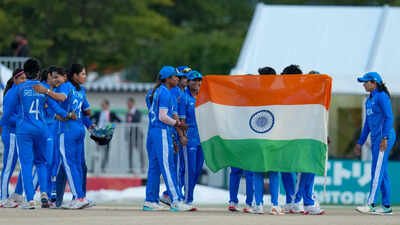

Nagoya: On the sidelines of the cricket facility at Korogi Athletic Park, a few Sri Lankan men sat watching the India-Sri Lanka women’s final. Not far away, an Australian kept a close eye on the proceedings.They were not casual spectators. They were among the men who helped turn a baseball ground in a public park on the outskirts of Nagoya into a cricket venue capable of hosting the best teams in Asia.Asian Games Full Coverage | Schedule | Medal TallyThe journey began in late September last year, when the decision was taken to include cricket in this edition of the Asian Games. A little over 300 million yen was earmarked to create the infrastructure, including temporary stands with a capacity of 2,500 spectators.Korogi was chosen because of the size of the facility. The Japan Cricket Association (JCA) also had a head start, having signed an MoU with Sri Lanka Cricket in March 2024, paving the way for Sri Lankan curators to be brought in.At the centre of the operation was Jarrad Shearer, an Australian who has lived in Japan for the past 30 years.“When it was decided that cricket would be part of the Asian Games, Alex Miyaji, the CEO of the JCA, approached me for a role because I had played some cricket back home in Perth and knew Japanese,” Shearer, a sports manager in the planning section of the organising committee, told TOI.The transformation was no small job. The existing facility consisted of three baseball diamonds, with lines of trees demarcating the playing areas. The first task was to clear the trees and level the ground.“We did the pitch and the outfield at the same time. While we were digging a hole to build the pitch, we were laying the outfield. So we created one hybrid wicket and four turf wickets,” said Shearer, who is also a Japanese translator by profession.Gamini de Silva, former curator of Bangladesh’s Sher-e-Bangla National Stadium, and Asitha Wijesinghe, curator of Sri Lanka’s Pallekele International Stadium, came on board. They were joined by a few Sri Lankan-origin residents of Japan who had experience as groundsmen.“While the four groundsmen are from here, Gamini and Asitha took turns to be here to oversee the preparations,” Shearer said.Pitch construction, however, presented one of the biggest challenges.“The pitch construction was interesting because we had a Japanese company doing it and they didn’t know anything about turf wickets. So our planning and instructions had to be spot on,” he said.The pitches were built using layers of gravel, washed riverbed soil and 15cm of local Japanese clay.“While we were testing the clay, we were informed that it was very similar to Pakistani clay,” Shearer said.The surface got its first serious test in May during the T20 World Cup East Asia-Pacific Qualifier, when six matches were played on the hybrid wicket.The plan was to use the turf wickets for the women’s competition, but heavy rain disrupted the schedule.“The heavy rain a couple of weeks ago upset our plans and we couldn’t get the turf wickets ready in time. But we are confident that the men’s tournament will be held on those wickets,” Shearer said.After October 3, when the men’s final is scheduled to be played, the facility will, in all probability, return to its original identity as a baseball ground for local children.For now, though, the men who transformed it into an Asian Games cricket venue can stand on the sidelines and take pride in what they have created.