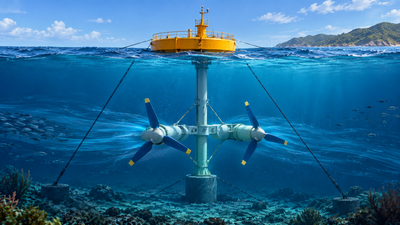
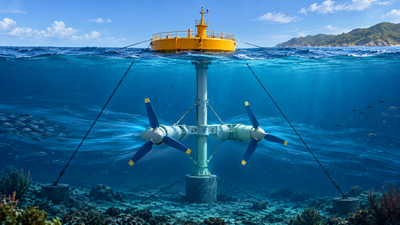
Japan tested a subsea floating power-generation system in the Kuroshio Current in 2017, exploring how the Pacific Ocean’s powerful current could be used to produce renewable electricity. According to the official press release, IHI Corporation and the New Energy and Industrial Technology Development Organisation (NEDO) completed the demonstration near Kuchinoshima in Kagoshima Prefecture. The system generated approximately 30 kW when operating in a current moving at 1.0 metres per second. The technology had previously achieved a rated output of 100 kW at 1.5 metres per second during a towing test. The demonstration also gathered data on underwater stability, autonomous control, installation and removal.
How Japan’s subsea system generated renewable energy
The Kuroshio Current provided the moving water needed to test the subsea floating system. The technology was designed to use the energy contained in a powerful ocean current. The demonstration took place at Kuchinoshima in Kagoshima Prefecture, with the machine installed in the Kuroshio Current near the Tokara Islands.The IHI and NEDO release says the demonstration produced approximately 30 kW when the current was moving at 1.0 metres per second. The test also collected data on the system’s autonomous control technology, which is responsible for its underwater position. Installation and removal procedures were examined as part of the project.
How the 100 kW ocean-current power test worked
The 100 kW figure associated with the project came from a separate towing test carried out before the offshore demonstration. During that test, the machine reached its rated power output of 100 kW at 1.5 metres per second. This distinction is important because the 100 kW result was not the power output recorded during the later Kuroshio Current demonstration.IHI and NEDO described the project as the “world’s first 100kW class demonstration test of ocean current power generation”. The organisations used the demonstration to obtain practical information about power output and the machine’s behaviour in the water. The results were intended to help assess the technology’s potential for future deployment in ocean currents.
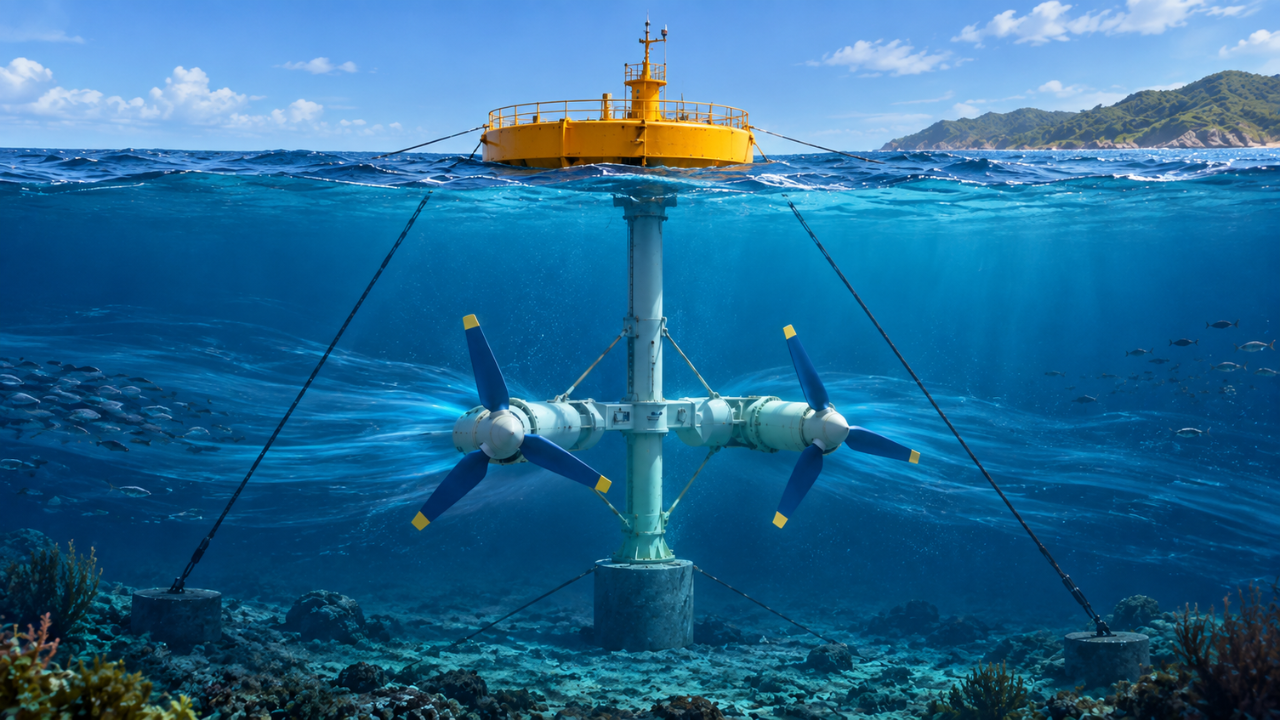
Image AI generated
Why ocean-current power could support renewable energy
Ocean-current power has one potential advantage over some other renewable sources: the movement of a major current can be relatively consistent. NEDO said ocean-current power generation could provide “large amounts of energy with few fluctuations”, making it a potential source of renewable energy. The 2017 test therefore focused on more than simply proving that the machine could produce electricity.The researchers also needed to understand whether a floating underwater system could maintain a stable position and operate in the demanding marine environment. The autonomous control system was tested for this reason, while the installation and removal methods provided additional information for possible future projects. These practical considerations were an important part of the demonstration.
Japan’s ocean-current power system moves toward practical use
The 2017 project represented a step towards using the movement of seawater as a renewable energy resource. IHI said it is aiming for practical application of its subsea floating ocean-current power generation system after 2020. The demonstration therefore served as a technology test, providing data that could be used to improve the system and assess what would be required for wider deployment.The results also show why the 100 kW figure needs to be placed in context. The machine achieved 100 kW at 1.5 m/s during the earlier towing test, while the offshore demonstration in the Kuroshio Current generated about 30 kW at 1.0 m/s. Together, these results showed both the machine’s rated output capability and its performance during an actual ocean-current demonstration.