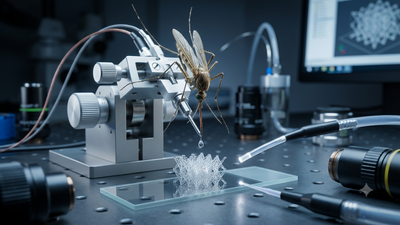
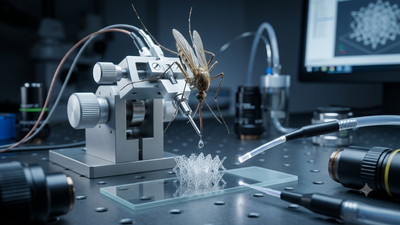
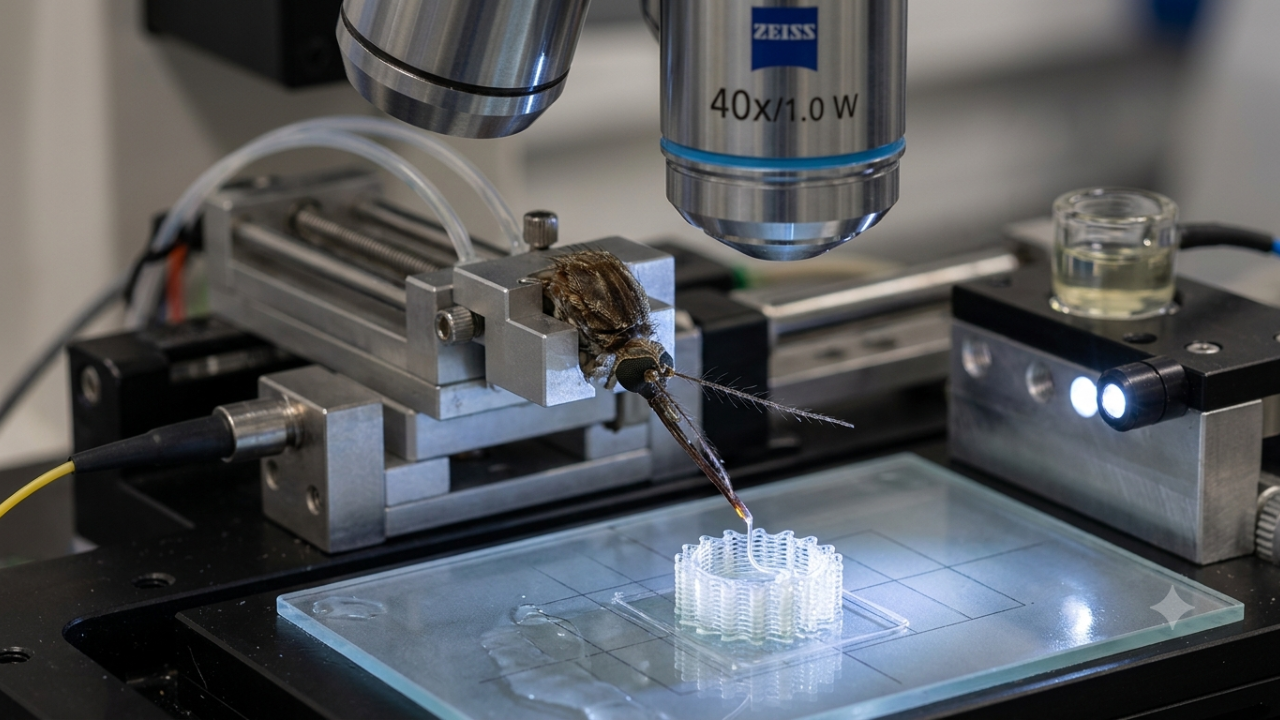
A mosquito’s proboscis is built for a very different job from manufacturing. It is a tiny biological structure designed to move through skin and handle fluid at a scale that is difficult to reproduce with conventional engineering. Now, researchers have found a way to put that natural geometry to work after the insect is dead.The technique, called “3D necroprinting”, uses female mosquito proboscides as miniature dispensing nozzles for 3D printing. The approach produced lines as narrow as 20 micrometres, while the biological tips were able to withstand pressures of about 60 kilopascals (kPa) during fluid extrusion. The experiments included intricate printed patterns and biological scaffolds containing cancer cells and red blood cells.
Scientists turned a mosquito’s tiny feeding tube into a 3D-printing tool
The work begins with an unusual decision: instead of manufacturing an increasingly small nozzle, the researchers repurposed a structure that evolution had already made extremely small.A mosquito’s proboscis has a particular combination of shape, internal structure and mechanical properties. Those features allow it to function as a narrow fluid pathway despite its minute size. For the researchers, that made the dead insect’s feeding apparatus potentially useful as a dispensing tip for precision manufacturing.The resulting process is described as 3D necroprinting because it incorporates material from a dead organism directly into an engineered system. The biological component is not simply being copied or used as a model. The actual proboscis becomes part of the printing hardware.
A mosquito proboscis became a precision 3D nozzle
According to the study published in Science Advances, titled ‘3D necroprinting: Leveraging biotic material as the nozzle for 3D printing’ revealed in testing, the mosquito proboscis produced printed lines down to about 20 μm wide. That was narrower than the 36-gauge dispensing tips used as a commercial comparison, with the researchers reporting roughly a 100% improvement in line-width resolution.At this scale, a difference of a few micrometres can change what a printing system is capable of producing. Structures that would otherwise require more specialised dispensing equipment can be formed through much smaller fluid paths.The natural nozzle was not only able to deliver the material. It also had to survive the pressure generated during extrusion. The researchers found that the mosquito proboscis could tolerate internal pressures of approximately 60 kPa, allowing it to function as a practical dispensing tip during the experiments.
Complex shapes were printed with the tiny tip
The researchers tested the method beyond simple lines. Among the structures produced were a honeycomb pattern and a maple leaf, showing that the biological nozzle could be used to trace relatively detailed shapes. The experiments also moved into biological applications. The team used the printing system to create bioscaffolds containing cancer cells and red blood cells.Such scaffolds are of interest because 3D printing can place biological material in controlled arrangements rather than depositing it randomly. At microscopic dimensions, the ability to regulate where material is placed becomes particularly important.The mosquito-derived nozzle therefore served two roles in the demonstrations. It provided the physical route through which the printing material was dispensed, while also showing that a biological component could be incorporated into a manufacturing system without first reproducing its complex structure artificially.
A mosquito proboscis becomes an engineering nozzle
The idea is based on a fairly direct engineering problem. Some manufactured components are difficult to miniaturise because their performance depends on geometry and material properties that become harder to maintain as dimensions shrink.The mosquito proboscis already has those characteristics. Its structure evolved for fluid handling at a tiny scale, so using the actual biological part avoids having to recreate every detail through conventional manufacturing.The approach also points towards a different way of thinking about biohybrid engineering. Rather than taking inspiration from nature and then building an artificial version, researchers can sometimes use biological structures themselves as functional components.That does not make the manufacturing problem disappear. Biological parts can vary, and their usefulness depends on whether they can withstand the conditions required by an engineered system. The pressure testing in this work was therefore an important part of establishing that the proboscis could operate as a printing nozzle.
A new role for biological materials in engineering
The experiments suggest that biological materials can serve as substitutes for some highly specialised engineered components. In this case, the mosquito proboscis supplied a ready-made microscopic dispensing structure capable of producing very fine features.The technique remains a research demonstration rather than a replacement for conventional 3D-printing hardware. Its significance lies in showing what can happen when a naturally occurring structure is used directly rather than merely copied as an engineering design.For microengineering and biohybrid manufacturing, that opens a rather unusual possibility. The next miniature component does not necessarily have to be manufactured from scratch. Sometimes, the part already exists in nature.