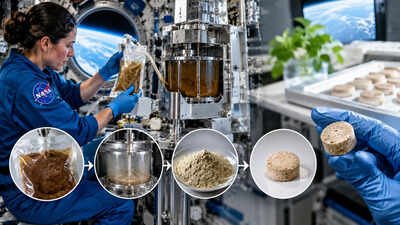
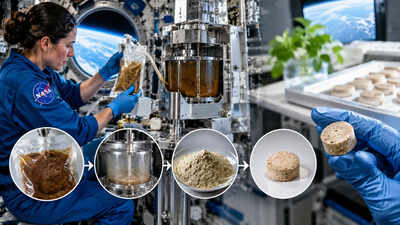
For astronauts travelling far beyond Earth, even the most ordinary human waste becomes a serious engineering problem. On a long-duration mission, there is no convenient rubbish collection, unlimited storage space or easy way to send unwanted material home. That is why Nasa has been investigating ways to transform waste into something safer, smaller and potentially useful. One such approach focuses on human faeces, exploring whether it can be processed into a stable material that is no longer biologically active and does not produce unpleasant odours. The idea is part of a wider effort to make future missions more self-sufficient by treating waste as a resource rather than something that simply has to be stored. Nasa’s TechPort project database describes research aimed at processing human waste for potential reuse, reflecting a broader shift towards closed-loop systems for future exploration.
Why astronaut waste becomes a problem in deep space
Waste management is relatively straightforward on Earth because rubbish can eventually be transported away, treated or discarded. Spacecraft do not have that luxury. Every kilogram launched into orbit requires energy, while storage takes up valuable volume that could otherwise be used for equipment, food or scientific supplies. Nasa has therefore been exploring technologies that can reduce waste and make spacecraft more sustainable. On the International Space Station, solid waste is generally stored and ultimately removed from the station, while other waste streams can be processed in different ways. Nasa has noted that high-temperature processing can break down small pieces of spacecraft rubbish into water, oxygen and other gases, while leaving behind material that has been greatly reduced in size and is no longer biologically active.
A closed-loop spacecraft could recycle what astronauts leave behind (Nasa)
Turning faeces into something safer to handle
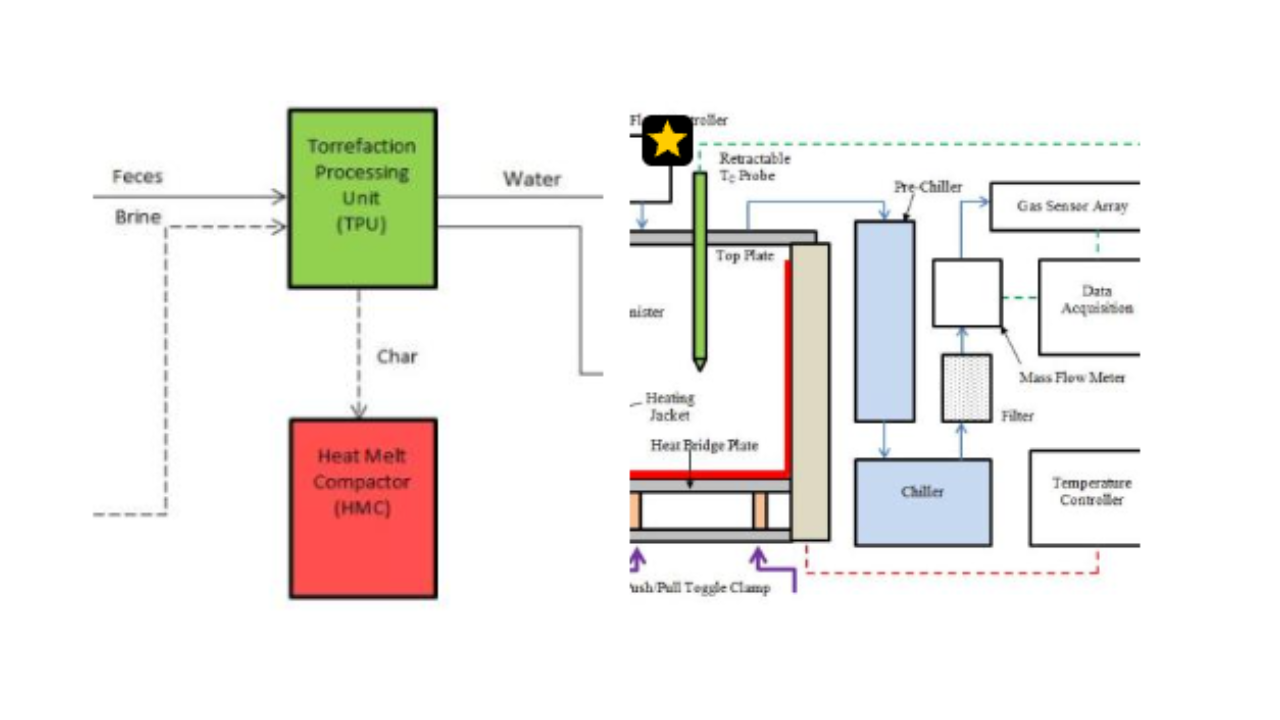
The challenge with human faeces is not simply its unpleasantness. Fresh biological waste contains microorganisms and organic compounds that can create health, hygiene and odour concerns. A useful treatment system therefore needs to do more than reduce its volume, it needs to make the resulting material safe and stable. Nasa’s TechPort project 89572 is focused on developing a process for treating human waste so that it can become a sterile, odour-free material with potential for recycling. The concept fits into a larger philosophy of resource recovery. Instead of viewing faeces as the final destination of nutrients and useful elements, engineers can investigate whether those materials can be recovered after treatment. For missions lasting months or years, such approaches could help reduce the amount of waste astronauts need to carry or store.
A closed-loop spacecraft could recycle what astronauts leave behind
Long-term exploration will require spacecraft and habitats to operate more like miniature ecosystems, where as little material as possible is thrown away. Nasa has repeatedly investigated ways of closing these resource loops because resupply becomes increasingly difficult as missions travel farther from Earth. Research has included converting waste into useful materials and recovering resources that would otherwise be discarded. Earlier Nasa-funded work, for example, explored biological systems capable of converting human waste into products such as food-related compounds, nutrients and materials. The same principle applies to solid waste, if treatment can make faeces sterile, remove its odour and produce a usable material, something that began as a disposal problem could potentially become part of the spacecraft’s resource cycle.
Why recycling astronaut poop could matter for Mars
The importance of this technology becomes clearer when considering a future crewed mission to Mars. A Mars expedition could involve years away from Earth, making regular resupply impractical. Every resource would therefore need to be used as efficiently as possible, from water and oxygen to food packaging and human waste. Nasa’s broader recycling research reflects this need to minimise waste and transform discarded material into useful resources. A process that turns human faeces into a sterile, odour-free material would not make the waste disappear, but it could make it considerably easier to manage and potentially recycle. The seemingly bizarre idea of recycling astronaut poop is therefore rooted in a serious engineering problem, how to keep humans alive and supplied when Earth is millions of kilometres away. For future deep-space missions, waste may ultimately be another resource waiting to be recovered.