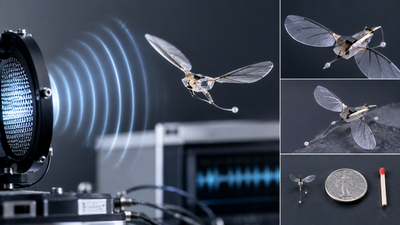
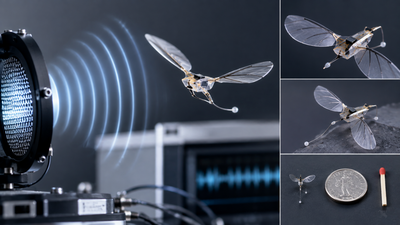
Engineers in Switzerland have worked out how to make miniature robots fly and steer without a single motor, magnet or battery on board. Researchers at the École Polytechnique Fédérale de Lausanne have built hollow structures that turn sound waves directly into thrust, drawing on Helmholtz resonance, the same physics behind the low hum produced by blowing across an empty bottle. The team, based at EPFL’s MicroBioRobotic Systems Lab, used the effect to steer small boats around obstacles and to lift tiny “microfliers” weighing barely more than a grain of rice off the ground. One design shot upward using direct thrust from three microscopic cavities, while a second spun tiny blades to generate helicopter-like lift at close to 13,000 revolutions per minute. Because the devices contain no moving mechanical parts beyond a printed cavity, they can be built at scales that would defeat conventional motors.
How does Helmholtz resonance help tiny robots generate thrust
The technology relies on Helmholtz resonance, the same phenomenon that produces a low hum when someone blows across the neck of an empty bottle. Air trapped inside a cavity oscillates in response to airflow passing over the opening, and at certain frequencies those oscillations become powerful enough to generate a directional jet. According to the study published in Science Advances, titled ‘Acoustic resonators as wireless actuators in air for small-scale robots’, the team “revisit the classical principle of Helmholtz resonance” and show that three-dimensional printed cavities ranging from centimetre to micrometre scale can generate thrust of between millinewton and micronewton strength once excited at resonance.Crucially, the shape of the cavity barely matters once it is far smaller than the sound wave driving it. The researchers tested spherical, cubic and cylindrical designs and found they produced broadly similar thrust, while the neck of each resonator turned out to be the decisive factor. A straight neck outperformed converging or diverging designs, and thinner walls produced noticeably more force than thicker ones. This gave the team a practical framework for scaling the approach up or down depending on the task at hand, whether that meant a fingernail-sized rotor or a robot smaller than a millimetre across.
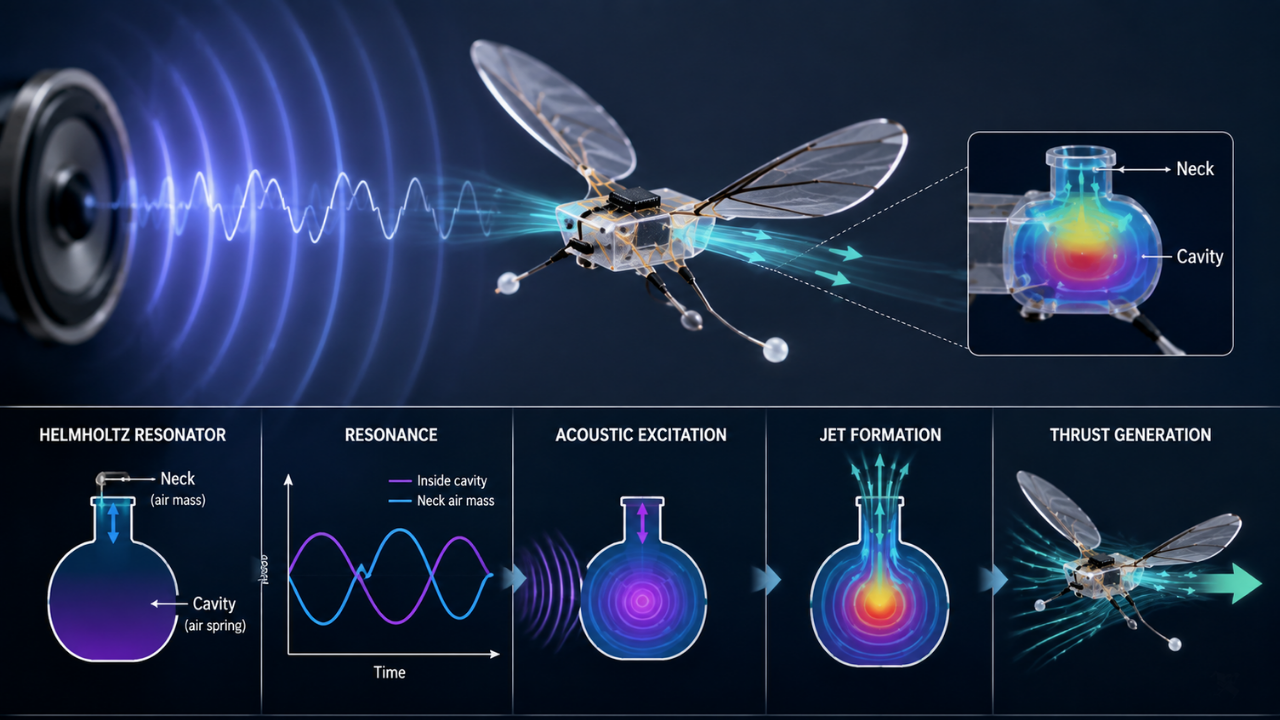
Image AI generated
How did acoustic resonators steer the tiny boats
Before attempting flight, the researchers proved the concept on the water. They built small boats fitted with acoustic resonators tuned to specific frequencies, each one dictating a different action: forward propulsion, a clockwise turn or a counterclockwise turn. One prototype was even piloted along a predefined path to spell out the letters “EPFL”, manoeuvring around obstacles without any contact.A second version of the boat carried its own battery, control electronics and vibration transducers, meaning it needed no external speaker at all. This structure-borne approach, in which a small onboard actuator directly vibrates the resonator, matched the thrust achieved by airborne sound while eliminating reliance on an external acoustic source. The team also demonstrated that two identical boats, when excited at the same frequency but facing in opposite directions, moved apart in a straight line rather than drifting towards the source of the sound, providing evidence that the propulsion came from the resonators themselves rather than from any external acoustic push.
Sound waves power two different microflier designs
Applying the same physics to flight required a considerable leap in miniaturisation. The team produced two types of “microflier”. One, weighing only 150 micrograms, used three microscopic resonators tuned to 40 kilohertz to generate direct vertical thrust, reaching a thrust-to-weight ratio of 4.9. According to the École Polytechnique Fédérale de Lausanne official press release, lab head Selman Sakar explained that “instead of pushing devices around with sound waves, we have created acoustic resonators that are tuned to harness sound at specific frequencies to generate directional thrust and controlled motion.“The second design, weighing 184 micrograms, took a different route by mounting tiny blades onto the resonators to spin like a rotor. Fitted with a circular arc airfoil and a small trailing-edge flap to improve lift, this version reached speeds of nearly 13,000 revolutions per minute during take-off before settling into a steady hover at around 6,500 rpm. High-speed footage showed that the rotary design flew more smoothly than the thrust-driven version, which the researchers attribute to a gyroscopic stabilising effect created by the spinning motion, similar to what keeps a spinning top upright.
Why motorless robots could transform miniature robotics
The devices need no motors, magnets or onboard batteries to fly; they sidestep one of the most persistent barriers to miniaturisation in robotics. Conventional motors cannot easily be below a certain size because of the physical components, such as coils and shafts, they depend on. First author Junsun Hwang noted that the “concept is compatible with even further miniaturisation, enabling advanced designs that push the boundaries of robotics and aeronautics.“The researchers see potential uses in areas where tiny, lightweight, electronics-free devices could prove valuable, including environmental monitoring, targeted delivery inside confined spaces, and exploration of environments too small or delicate for conventional machinery. For now, the microfliers remain laboratory prototypes that depend on a carefully controlled external ultrasonic field to operate, meaning true autonomous flight is still some way off.