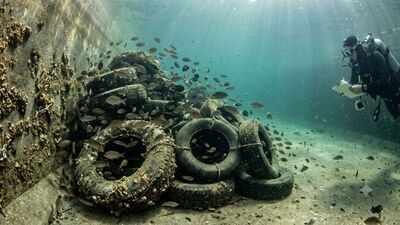
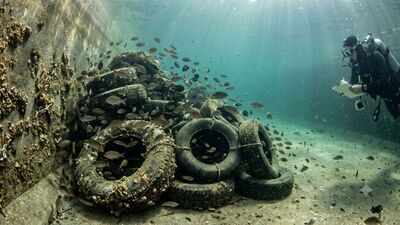
When engineers lined canals across the dry American Southwest with concrete, they solved one problem while creating another. The hard surfaces helped stop precious water from disappearing into the soil, but they also stripped away the irregular edges, vegetation and sheltered spaces that aquatic life had used in the old earthen channels. Fish eventually returned, yet their numbers, diversity and biomass remained lower. In 1994, researchers Gordon Mueller and Charles R. Liston tried an unusual fix in the Coachella Canal in California and the Hayden-Rhodes Aqueduct in Arizona: they placed low-profile reefs made from discarded tyres in the water.As reported by USGS, areas around the tyre reefs supported about three times as many invertebrates and roughly 20 times as many fish as ordinary canal sections without them. What looked like waste became underwater habitat, showing how a few simple structures could transform parts of an otherwise barren concrete waterway.
Concrete canals saved water but left fish with a far less suitable home
Large canals across the arid Southwest were increasingly being lined with concrete because water could seep through the soil of traditional earthen channels. With water supplies under pressure, reducing that seepage was an important engineering goal. But the new surfaces came with an ecological trade-off.An earthen canal contains irregular edges, sediments, vegetation and other features that can provide places for aquatic organisms to hide, feed and reproduce. A concrete-lined channel is much more uniform. Water can also move faster through it.Fish communities could eventually return to these waterways, but they did not necessarily return in the same numbers or variety. The researchers noted that fish communities in the concrete canals had lower species diversity, density and biomass than those found in the former earthen canals.The problem was not simply whether fish could survive there. The canal had lost much of the structure that made it a useful habitat.
How used tyres changed the shape of the canal habitat
The researchers tested whether that missing structure could be recreated without rebuilding the canals.Instead of changing the concrete itself, they installed low-profile reefs made from used tyres. The structures introduced physical complexity into otherwise smooth sections of the waterways. For fish, even a relatively small change in the shape of the canal can create new possibilities. A structure can interrupt the flow, provide shelter and give smaller organisms surfaces on which to live.The tyres therefore served a purpose quite different from their original one. Rather than being waste sitting in a landfill or discarded somewhere else, they became part of an artificial underwater habitat.The researchers compared areas around the tyre reefs with typical canal sections that did not contain them.
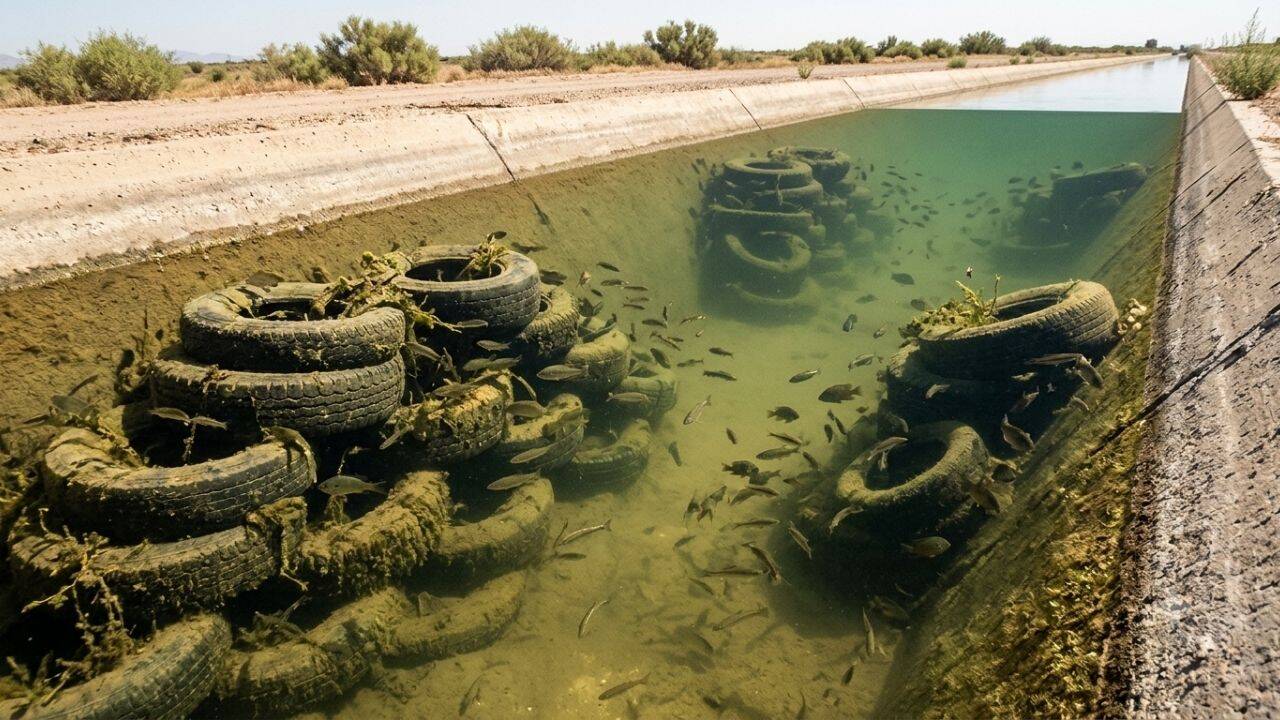
Fish numbers were 20 times higher around the tyre reefs
The reef areas supported roughly three times the density of invertebrates found in ordinary canal sections. That matters because small aquatic animals sit near the bottom of the food web. Insects and other invertebrates provide food for fish and can also benefit from the additional surfaces and shelter created by the structures.The tyre reefs effectively gave these organisms more places to occupy in an environment that otherwise offered relatively little physical variation. The increase in invertebrates was accompanied by an even more dramatic change higher up the food chain.Fish densities were about 20 times higher in the reef areas than in typical sections without reefs. That did not mean the entire canal suddenly became a natural stream. The underlying waterway remained a concrete-lined canal, designed primarily to move water efficiently.
A strange second life for discarded tyres
The experiment also highlighted an idea that has appeared repeatedly in environmental engineering: materials considered waste can sometimes be given a useful second role.Old tyres are difficult to dispose of because they are durable and take up considerable space. Turning them into structures has therefore attracted interest in different aquatic and coastal settings.The 1994 study was not claiming that tyres could solve every ecological problem caused by canal construction. Its focus was much narrower: whether tyre reefs could improve aquatic communities in concrete-lined canals. Rather than attempting to remove the concrete or return an entire canal to its former condition, researchers created small areas of habitat within the existing infrastructure.
The experiment showed how much habitat can matter
The most striking part of the study was not simply that fish appeared around the tyres. Fish had already reestablished themselves in the canals. The problem was the quality and quantity of habitat available to them.Adding structure changed that equation. A smooth concrete channel may be efficient for moving water, but efficiency for engineering purposes does not necessarily translate into good conditions for wildlife. The tyre reefs introduced places where aquatic organisms could concentrate, creating pockets of greater biological activity within an otherwise simplified environment.The jump in fish density showed just how strongly aquatic communities could respond to those changes. The researchers ultimately recommended tire reefs as an effective method for enhancing aquatic communities in concrete canals.